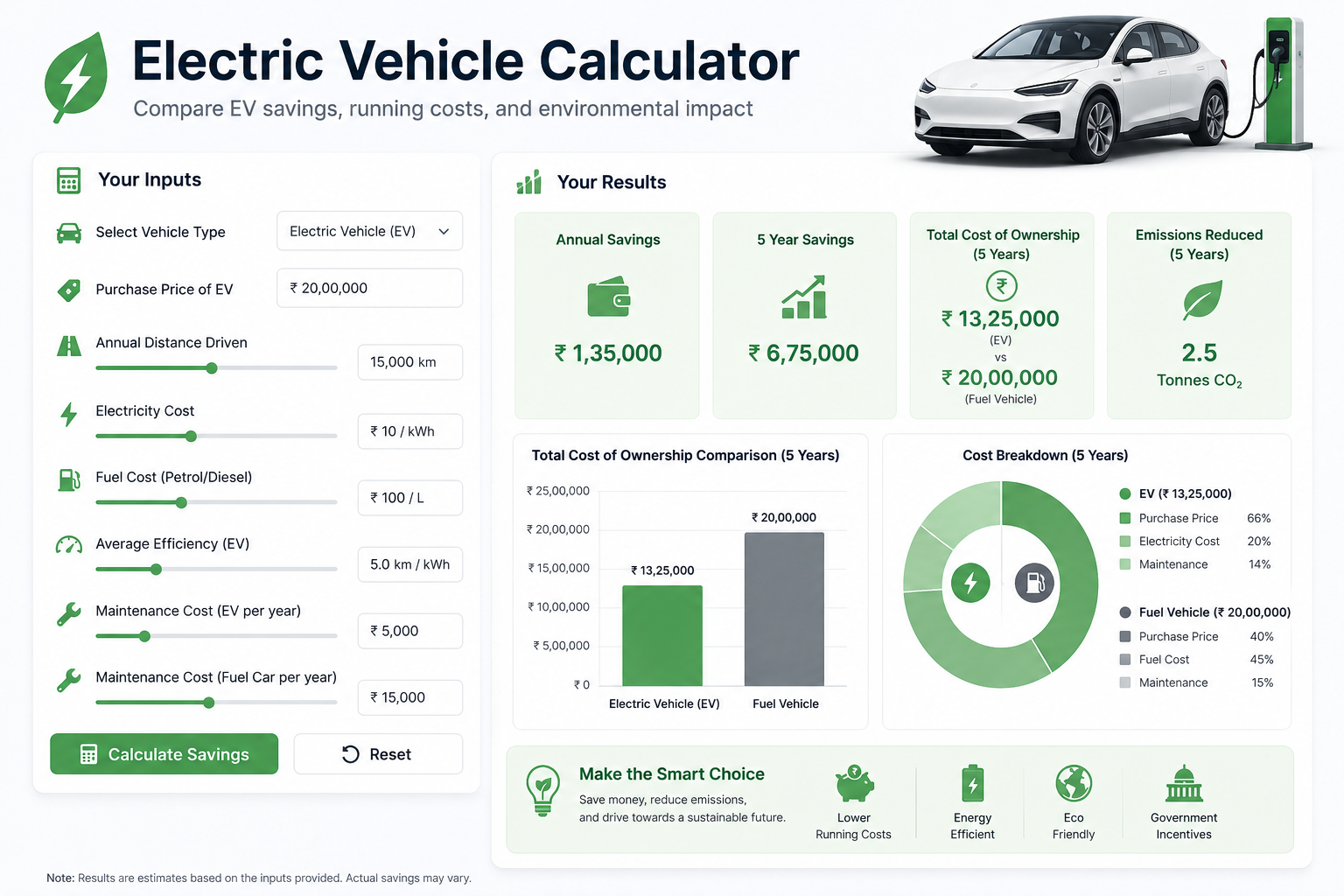
How much will an EV cost once it leaves the dealership, plugs in at home, and starts covering your daily miles? An electric vehicle calculator turns that fuzzy question into numbers you can compare.
Enter a vehicle, your annual mileage, local energy prices, gas prices, and likely incentives. The result won’t predict every bill perfectly, because weather, charging habits, utility plans, and incentive rules can shift. Still, it gives you a practical place to start.
Use the estimates as a map, then pressure-test them against how and where you actually drive.
How an electric vehicle calculator turns inputs into useful answers
A basic calculator estimates the electricity needed for a trip or a year of driving. A broader ownership calculator also compares an EV with a gasoline vehicle, estimates emissions, tracks maintenance, and shows when higher upfront costs may be recovered.
The most useful outputs include charging cost, cost per mile, annual energy savings, total cost of ownership, estimated break-even time, and trip charging needs. The U.S. Department of Energy’s Vehicle Cost Calculator compares vehicle ownership costs and emissions using vehicle models and driving assumptions.

Quick energy estimates versus ownership estimates
A charging-cost tool answers a narrow question: “What will the electricity cost?” It usually needs miles per kWh, electricity price, and driving distance.
An ownership tool takes the longer view. It can add purchase price, loan interest, insurance, taxes, maintenance, depreciation, incentives, and charger installation. Both are useful, but their results should never be treated as interchangeable.
Low charging cost does not automatically make an EV cheaper to own. Depreciation, financing, and insurance can outweigh a year of electricity savings.
Enter the right details before trusting the math
A credible electric vehicle calculator depends on its inputs. Start with the EV make and model, usable battery capacity, expected range, annual miles, local electricity price, gasoline price, and the fuel economy of the car you would otherwise drive.
Also enter your charging mix. A driver with a garage and off-peak utility pricing has a different result than an apartment resident who relies on public fast chargers.
Usable battery capacity and real-world efficiency
The battery number in a brochure is not always the energy available for driving. Manufacturers often hold back a small buffer to protect the pack, so usable capacity is more relevant than gross capacity.
Efficiency matters just as much. An EV rated at 3.5 miles per kWh will use less electricity than one averaging 2.5 miles per kWh. For a broader reference point, compare EV energy consumption figures alongside a model’s EPA range rating.
Cold weather, steep grades, highway speeds, roof racks, heavy loads, and cabin heating can all raise consumption. A calculator should allow you to revise efficiency when winter arrives.
The formulas behind cost per mile
Charging cost is based on energy added to the battery, charging losses, and the price per kWh:
Energy billed = battery energy added / charging efficiency
Suppose an EV has a usable 75 kWh battery. A full refill with a 10% charging loss draws about 83.3 kWh from the grid. At an assumed local rate of $0.18 per kWh, that charge costs about $15.
If that energy produces 300 miles of driving, the energy cost is roughly 5 cents per mile. A gas vehicle gets its own formula:
Gas cost per mile = gasoline price / miles per gallon
The figures are simple, yet the price and efficiency assumptions decide the outcome.
Compare home charging, public charging, and gas costs
Home charging usually costs less because you pay your residential electricity rate. Public Level 2 charging may cost more, while DC fast charging can carry higher per-kWh prices, session fees, membership pricing, or time-based charges.
For that reason, don’t assume every mile is home-charged. Use a realistic split, such as 75% home, 15% public Level 2, and 10% DC fast charging. A helpful home charging cost-per-mile calculator can help check the home portion of your estimate.
Why utility rates and gas prices move the result
National averages are fine for a rough first pass. They can mislead when your local utility rate is far above or below the average.
Time-of-use plans can make overnight charging cheaper, while seasonal rate changes may raise summer bills. Workplace or destination charging may lower your effective rate, although free charging should not be assumed forever. The Energy Information Administration’s daily energy price data also changes frequently, so update gasoline assumptions before comparing models.
A simple EV versus gas worked example
Assume 12,000 annual miles, an EV efficiency of 3.5 miles per kWh, and home electricity at $0.16 per kWh. The EV uses about 3,429 kWh per year and costs about $549 in driving energy.
Now compare a 30 mpg gasoline vehicle with gas priced at $3.50 per gallon. It uses 400 gallons and costs $1,400 per year. The EV saves about $851 in annual driving energy, or roughly 7.1 cents per mile.
That comparison excludes purchase price, insurance, maintenance, financing, taxes, and depreciation. For a closer fuel-only view, see this breakdown of gasoline car fuel costs versus EV charging costs.
Use total cost of ownership to find the real payback
Fuel savings are only one line in the ownership ledger. A five-year total cost of ownership calculation should include the purchase price, sales tax, registration, loan interest, insurance, charging equipment, maintenance, tires, electricity, and expected resale value.
The break-even point is when lower operating costs recover any added upfront cost. If an EV costs $6,000 more to buy but saves $1,200 each year after all operating costs, the simple payback is five years. Real ownership math can change when interest or depreciation enters the picture.
The federal vehicle cost comparison tool is useful for checking lifetime operating costs and emissions across fuel types.
Incentives and home charger expenses
Do not subtract a tax credit automatically. As of August 2026, the federal consumer clean vehicle credits are not available for vehicles acquired after September 30, 2025. State, local, utility, and dealer programs may still exist, but eligibility depends on location, income, vehicle, purchase date, and available funding.
A home Level 2 setup also has a real cost. Include the charging unit, permit, electrical work, and installation. The federal alternative-fuel refueling property credit applied to eligible property placed in service through June 30, 2026, so older calculator templates may contain expired assumptions.
Ownership costs that often get missed
EVs need less routine service because they have no oil changes, spark plugs, or exhaust system. However, maintenance isn’t zero. Tires can be expensive, particularly on heavier or high-performance models.
Insurance premiums, annual registration fees, loan rates, collision repairs, and resale value can swing a comparison. Compare vehicles in the same class and use the same ownership period. A compact EV should not be judged against a much larger gasoline SUV unless that is the real alternative.
Choose a calculator that shows its assumptions
The best electric vehicle calculator makes its assumptions visible. You should be able to see the selected vehicle, local electricity and gas prices, annual mileage, charging locations, and ownership period.
A calculator that hides those details may offer a clean number but weak decision support. The Department of Energy’s calculator, for example, allows drivers to personalize comparisons with vehicle and driving data. A report on the tool’s launch describes its ability to account for driving habits, local fuel prices, ZIP code, and tax credits in its estimates.
Match the tool to the question
Use a charging-cost calculator when you want to price daily driving. Choose an EV-versus-gas tool when fuel savings are your main concern. Select a total-cost calculator before committing to a purchase or lease.
Route planners answer a different question. They estimate charging stops and travel time, not long-term ownership cost. Running more than one tool is often smarter than relying on a single tidy result.
Plan charging time and trips with real conditions in mind
Energy cost and charging time are separate calculations. Level 1 charging uses a standard 120-volt outlet and often adds only a few miles of range per hour. Level 2 charging is the common choice for home daily charging, while DC fast charging is built for quicker stops on longer drives.
Battery size, charger power, starting charge level, and the vehicle’s maximum acceptance rate all affect the wait. Fast-charging sessions usually focus on the 10% to 80% range because charging slows as the battery approaches full.

Use a practical range reserve
A road-trip estimate should include weather, wind, elevation, highway speed, traffic, and a buffer at arrival. Planning around the maximum advertised range leaves little room for a missed charger or a cold snap.
Route tools also need current station information. Charger availability, connector compatibility, and station power can change the length of a stop.
Test best-case, typical, and difficult scenarios
Run the same vehicle through three versions of your life. First, use favorable assumptions: low electricity cost, strong home-charging access, and full incentive eligibility. Next, enter the conditions you expect most often.
Finally, test a difficult case with more public charging, winter efficiency losses, higher electricity rates, and no incentives. If the EV still produces acceptable annual savings and a reasonable payback period, the choice rests on firmer ground.
A calculator is a starting point, not a promise
An electric vehicle calculator becomes useful when it reflects your own mileage, charging pattern, local energy prices, and full ownership costs. Begin with cost per mile, then compare five-year ownership totals and payback.
Check current vehicle pricing, electricity rates, gasoline prices, and incentive rules before you sign. Realistic assumptions matter more than the lowest possible estimate.