A battery can decide whether an electric car feels effortless or frustrating long before you press the accelerator. It shapes the price, the usable range, charging stops, winter behavior, and even how long the car remains a good daily companion.
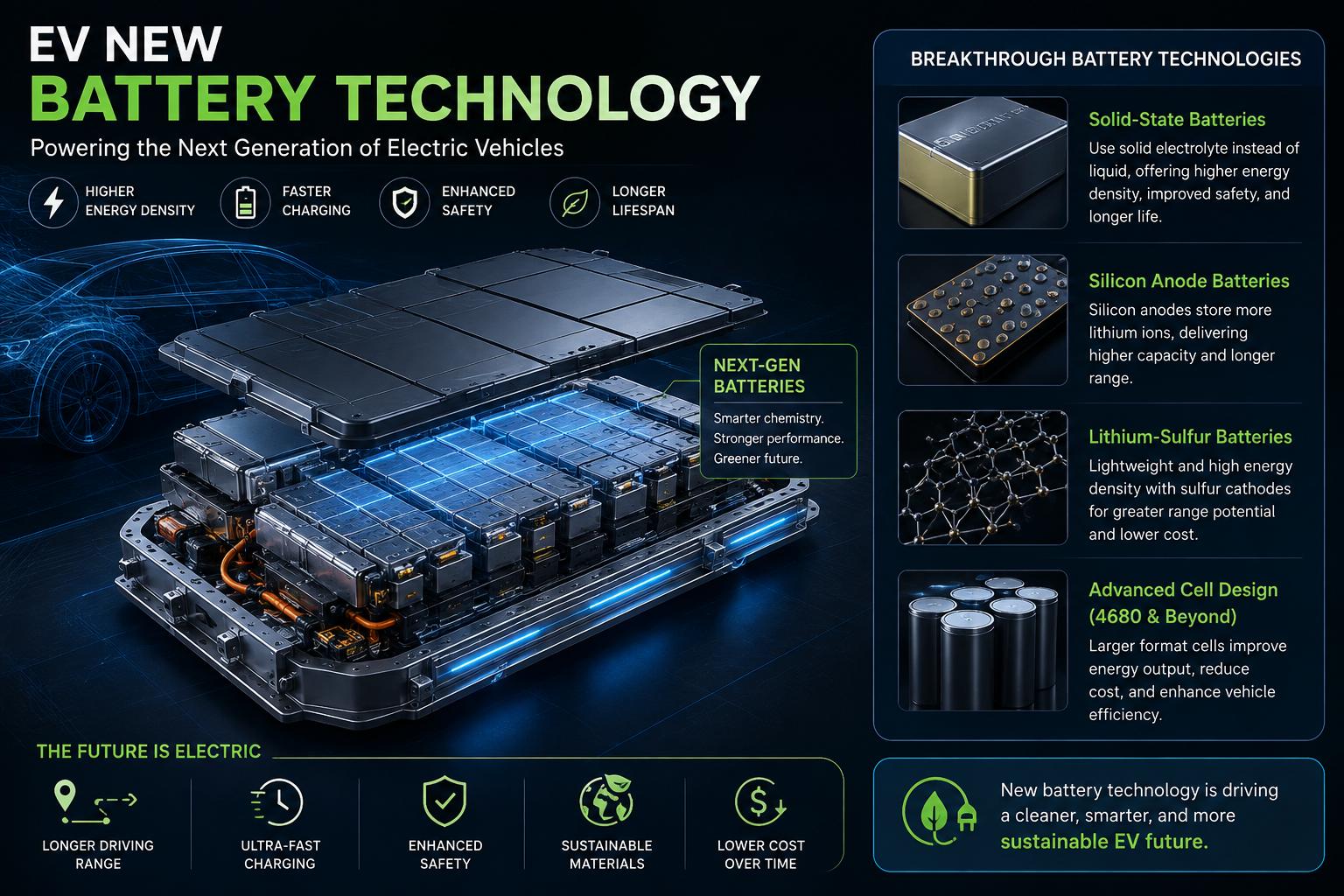
EV new battery technology is moving on several tracks at once. LFP and NMC cells power most cars today, while sodium-ion, silicon-anode, and solid-state batteries pursue lower costs, faster charging, or longer range. For buyers in the US and India, the key is separating showroom-ready progress from laboratory promises.
How ev new battery technology is improving electric cars
A better EV battery is not simply the one with the biggest range figure. Drivers should compare energy density, charging curve, cycle life, safety, weather performance, material supply, and cost. A dense battery can reduce weight, yet a durable lower-cost pack may suit daily commuting far better.
For a wider EV battery chemistry comparison, it helps to view each design as a different compromise.
| Battery type | Typical strength | Main tradeoff |
|---|---|---|
| LFP | Long life and lower cost | Lower energy density |
| NMC | Compact long-range packs | Higher material cost |
| Sodium-ion | Lower-cost material supply | Less range per pound |
| Silicon-enhanced | Higher capacity and faster charging potential | Harder to engineer |
| Solid-state | High theoretical energy density | Not yet broadly available |
The cell matters, but the complete pack decides what you experience on the road.
LFP and NMC batteries still lead different parts of the market
LFP, short for lithium iron phosphate, has become the practical choice for many lower-priced EVs. Newer cells can reach roughly 205 Wh/kg, while published estimates have placed some LFP cell costs near $80 per kWh. They can also exceed 3,000 charge cycles and tolerate heat well.
NMC cells, which use nickel, manganese, and cobalt, can approach 265 Wh/kg. That extra density helps premium EVs carry more range without a huge, heavy pack. However, NMC usually costs more and has greater exposure to nickel supply. This LFP, NMC, and solid-state battery guide outlines why the chemistry choice remains tied to the vehicle’s price and purpose.
Why battery packs and software matter as much as chemistry
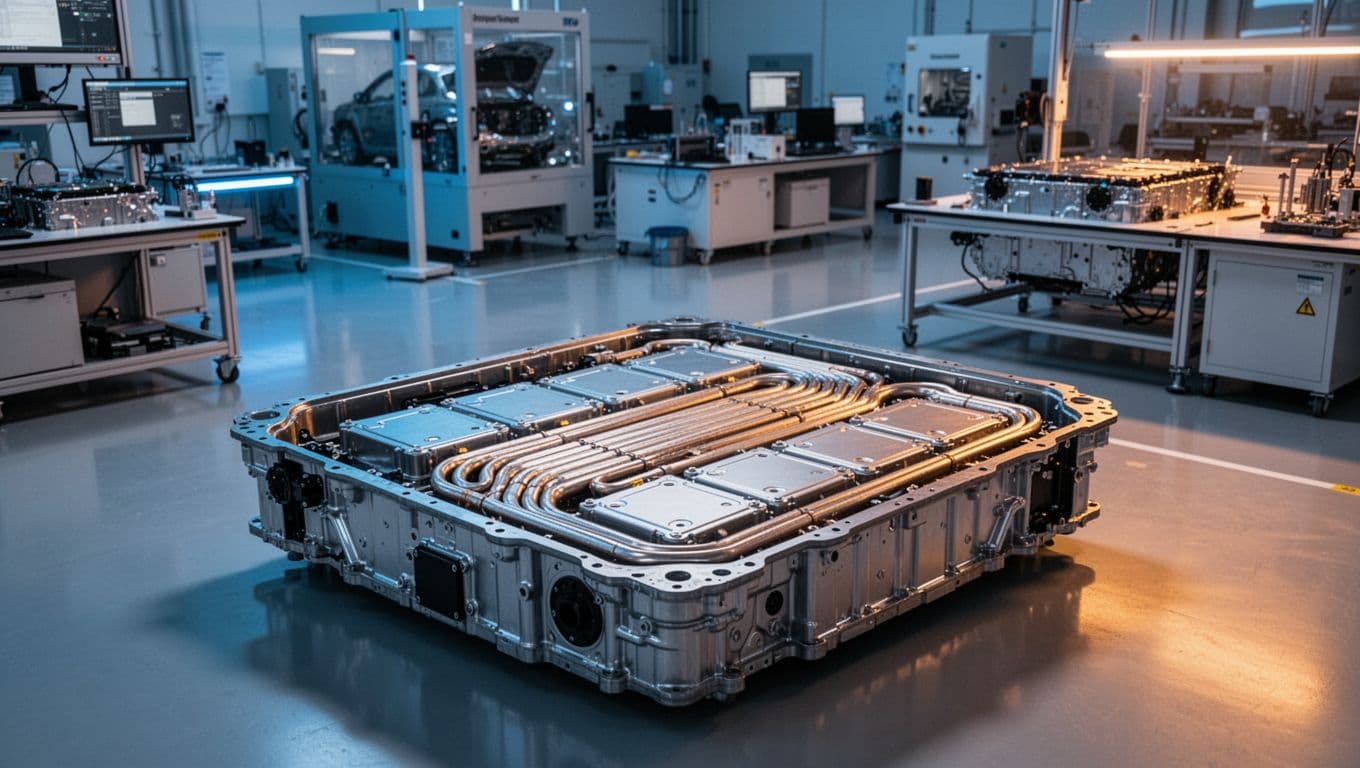
Two cars with similar cells can deliver very different results. Cell-to-pack construction removes unnecessary material, while liquid cooling, thermal controls, and charging software protect cells during hard use.
Speed, temperature, tire choice, battery size, and charger output also change real-world range. A battery’s advertised number is a useful starting point, not a guarantee for every highway trip or winter morning.
Sodium-ion batteries could make affordable EVs more practical
Sodium-ion batteries are the most important lower-cost chemistry entering real passenger-car production. Sodium is abundant and widely distributed, which could reduce pressure on lithium supply chains and help manufacturers build affordable packs closer to their markets.
The catch is energy density. CATL’s Naxtra sodium-ion cells are reported at up to 175 Wh/kg, below leading LFP and NMC cells. That makes them a natural fit for city cars, buses, battery-swapping systems, and vehicles where modest range is acceptable.
CATL and BYD have both invested in sodium-ion development. In February 2026, CATL and Changan unveiled the Nevo A06, also called the Qiyuan A06 in some reports, as the first mass-produced passenger EV program using sodium-ion cells. The reported version uses a 45 kWh pack and targets more than 400 km on the CLTC test cycle.
Early production in China does not mean broad availability in the US or India. Still, it turns sodium-ion from a future concept into a real market test.
Cold-weather performance is sodium-ion’s biggest advantage
CATL says newer sodium-ion cells can retain about 90% of nominal capacity at minus 40 degrees Celsius and operate in temperatures up to 70 degrees Celsius. The company also claims almost three times the discharge power of an equivalent LFP cell at minus 30 degrees Celsius.
Those claims need independent, long-term testing across many vehicles. Durability, final vehicle price, local service support, and charging performance still matter. For Indian buyers, lower material cost and flexible supply may prove more important than extreme-cold capability.
Sodium-ion’s near-term appeal is not record range. It is the chance to make a dependable EV with fewer expensive materials.
Silicon-anode batteries are bringing faster charging sooner
Silicon can hold far more lithium than graphite, the standard anode material in most lithium-ion cells. Yet pure silicon swells dramatically during charging and discharging, which can crack an electrode and shorten battery life. Manufacturers usually blend silicon with graphite instead.
That blend can lift energy density, support greater charging power, or permit a smaller pack for the same range. Unlike all-solid-state designs, silicon-enhanced cells are already moving into premium vehicle programs.
Mercedes-AMG has reported that its forthcoming GT 4-Door Coupé uses a silicon-containing anode. Its cell-level target is about 298 Wh/kg, with charging power up to 600 kW and a claimed 10% to 80% recharge in roughly 11 minutes under suitable conditions. Such figures belong to a high-performance system, not a typical public charging session. Work on high-energy, fast-charging solid-state cells also shows how anode materials and cell design increasingly overlap.
What silicon anodes mean for range and charging stops
A successful silicon blend gives automakers choices. They can add range without adding as much mass, shrink the pack while holding range steady, or prioritize fast charging for long-distance driving.
However, the charger is only one part of the equation. Battery temperature, the charging curve, cable capacity, vehicle voltage architecture, and the local grid all set limits. A 600 kW peak figure doesn’t mean every stop will take 11 minutes.
Solid-state batteries promise more range, but they are not here yet
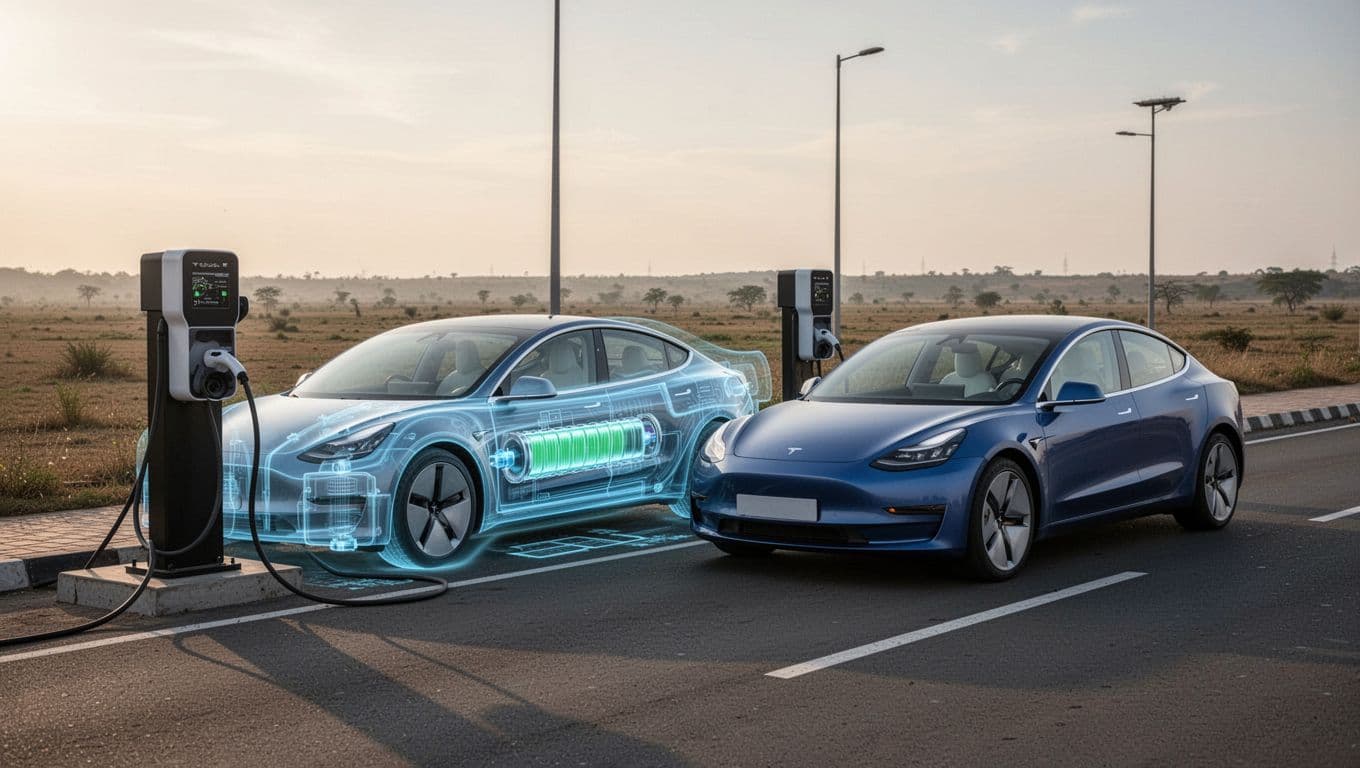
Conventional lithium-ion cells use a liquid electrolyte to move ions between electrodes. Solid-state batteries replace that liquid with a solid material. In theory, the change can improve safety, raise energy density, and make lithium-metal anodes more practical.
The engineering is difficult. Manufacturers must control microscopic defects, maintain performance through repeated expansion and contraction, achieve reliable fast charging, and produce cells with good yields. A promising laboratory cell can still struggle on a factory line.
Pilot programs and validation vehicles are more common than true mass-market solid-state EVs in 2026. Many companies discuss wider industrialization between 2027 and 2030. CATL has indicated that million-unit-scale production is unlikely before around 2030.
Real solid-state battery examples to watch
Mercedes-Benz and Factorial Energy have provided one of the clearest road-going demonstrations. A specially equipped EQS drove 1,205 km from Stuttgart to Malmo on one charge with lithium-metal solid-state cells. Mercedes says the pack offers about 25% more usable energy at a similar size and weight, as described in its EQS solid-state battery test.
Dongfeng has reported pilot-line activity and future production targets. GAC, FAW, CATL, and Geely have also discussed development plans. These are pilots, targets, or reported programs, not evidence that solid-state cars are already common at dealerships. An IEEE review of Mercedes and Factorial’s testing captures the gap between a successful demonstration and large-scale production.
When will solid-state EV batteries reach regular buyers?
Sodium-ion passenger EVs and limited semi-solid battery activity are the nearer-term stories in 2026. If manufacturing improves, broader solid-state industrialization could arrive in 2027 or 2028, although meaningful scale may take until 2030 or later.
A concept car or test vehicle is not a reason to delay buying an EV that already suits your needs. That is especially true in India, where price, charging access, and after-sales support often matter more than an announced chemistry.
Which new EV battery technology makes the most sense for you?
LFP is the strongest mainstream choice for buyers who want a reasonable price, long battery life, and a stable pack for daily use. NMC makes sense when you need maximum range from a compact, lighter battery.
Sodium-ion deserves attention in future budget models, especially urban EVs and commercial fleets. Silicon-enhanced cells fit premium buyers who value quick highway charging and top-tier performance. Solid-state batteries remain a technology to watch rather than a purchase requirement.
Check the vehicle around the battery
Before choosing an EV, compare more than the chemistry name. Look at the battery warranty, usable capacity, charging curve, thermal management, service network, replacement cost, and real-world range in your climate.
For US buyers, public fast-charging access can change the value of a smaller, quicker-charging pack. In India, LFP remains the most sensible mainstream chemistry today, NMC still matters for premium range, and sodium-ion is the near-term development to follow.
Conclusion
LFP and NMC will continue to meet different price and range needs for years. Sodium-ion could lower the cost of useful EVs, while silicon-anode designs can bring faster charging and more energy density before solid-state cells arrive at scale.
The best choice is the complete vehicle package, including range, climate, charging access, warranty, price, and how you drive. The best EV battery technology will always depend on the job it has to perform.