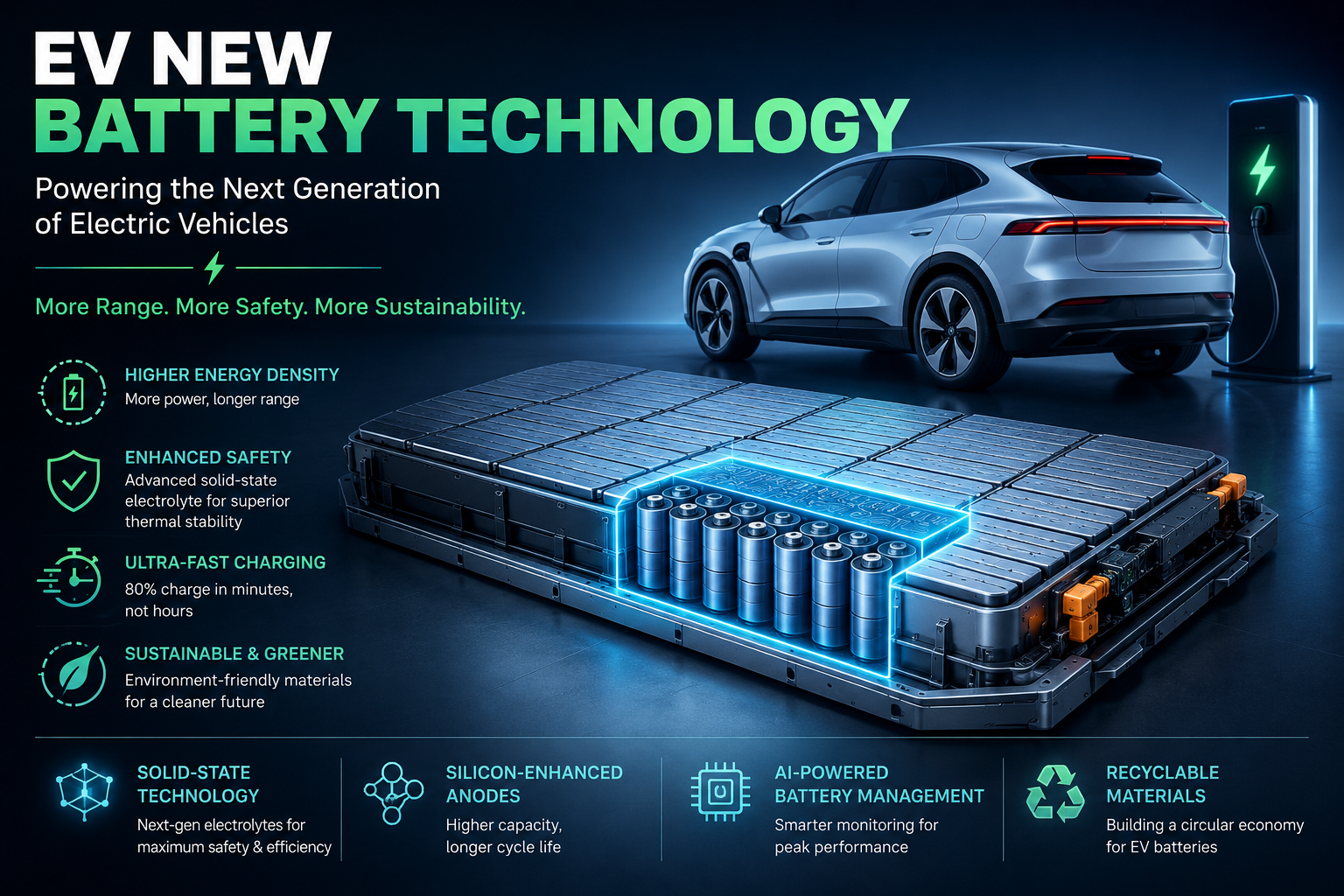
A battery shapes almost every part of an electric car you feel, including range, charging time, price, safety, and how long the vehicle stays useful. EV new battery technology matters, but the newest chemistry isn’t automatically the best choice for your commute or budget.
As of August 2026, LFP and NMC packs still power most new EVs. Sodium-ion cells have reached early commercial vehicles, while solid-state and lithium-sulfur batteries remain future-facing technologies. The sensible choice depends on where you drive, how you charge, and what you expect to keep for years.
EV New Battery Technology: What Is Ready Now and What Comes Next
Battery progress comes in layers. Chemistry gets the headlines, yet an EV’s battery also includes the anode, electrolyte, battery-management software, cooling system, cell format, and the pack structure under the floor.
For a wider comparison, see this EV battery technology guide. It helps place familiar lithium-ion packs beside newer sodium-ion and solid-state options.
Higher energy density sounds like a clear win. However, it can bring higher costs, harder thermal control, and shorter life under repeated fast charging. A durable, affordable pack often delivers more value than a lighter pack with an impressive lab number.
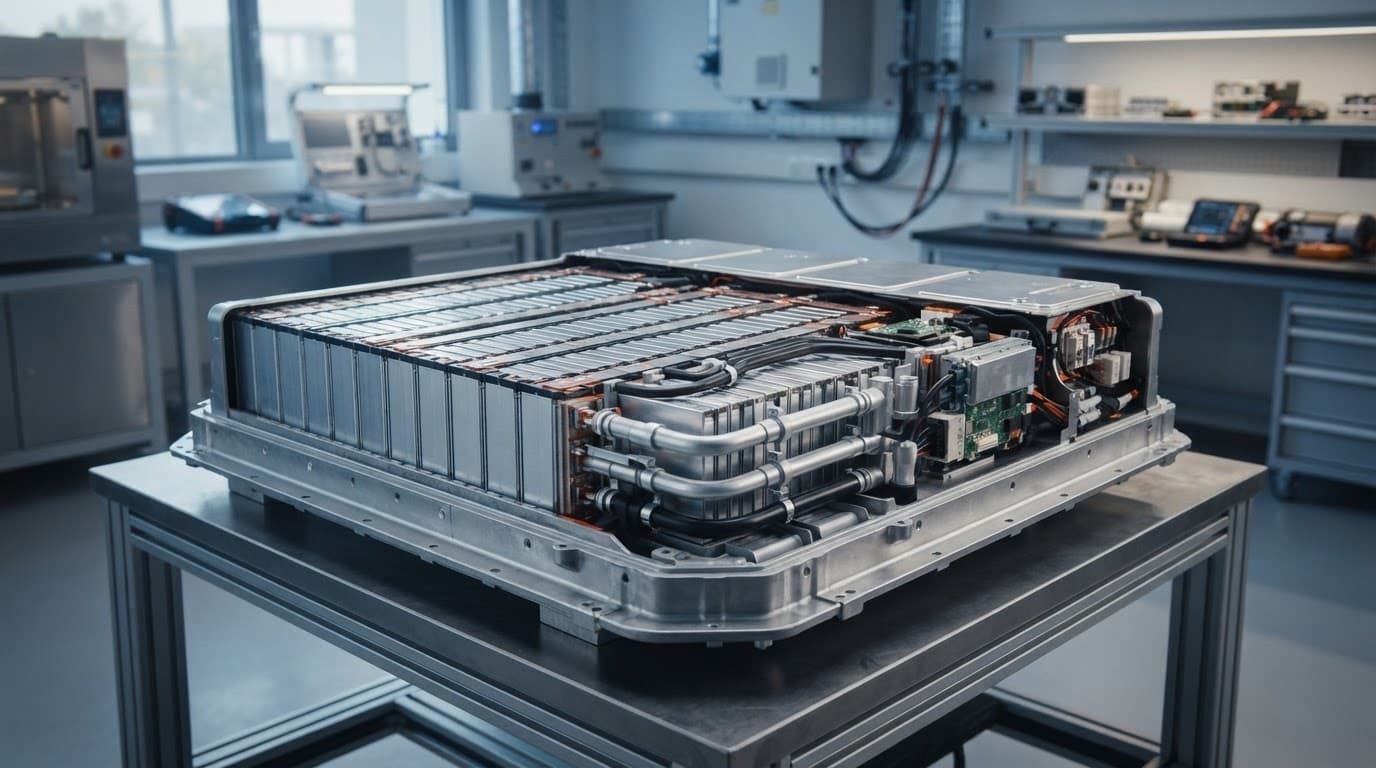
LFP and NMC remain the main choices for electric vehicles
Lithium iron phosphate, called LFP, has become a default chemistry for value-focused cars, city EVs, buses, fleets, and grid storage. It contains no cobalt, handles heat well, and can tolerate many charge cycles. Owners who charge frequently often appreciate its long service life.
Nickel manganese cobalt, or NMC, and nickel cobalt aluminum, or NCA, deliver more energy in less space. That makes them useful in premium EVs and long-range models, where pack size and weight matter.
The IEA’s 2026 battery analysis reports that LFP packs were more than 40% cheaper per kWh than NMC alternatives in 2025. It also puts leading cell energy density at about 205 Wh/kg for LFP and 265 Wh/kg for NMC. Those figures explain why neither chemistry has pushed the other aside.
Sodium-ion batteries are reaching early vehicles
Sodium is more abundant than lithium and reduces dependence on nickel, cobalt, and other strained mineral supply chains. That makes sodium-ion attractive for lower-cost EVs, especially two-wheelers, three-wheelers, buses, urban cars, and stationary storage.
The trade-off is weight. Newer sodium-ion cells can reach about 175 Wh/kg, but that remains below current LFP and NMC cells. Still, sodium-ion cells can perform well in cold conditions, an advantage for commercial fleets in harsh climates.
CATL’s Naxtra program has moved beyond a lab announcement. CATL and Changan introduced the sodium-ion-powered Changan Nevo A06 in 2026, with a reported 45 kWh pack. In India, Reliance’s Faradion operation and Jamnagar plans keep sodium-ion on the radar, while Rechargion Energy and Macsen Labs are among the companies working in this space.
How New EV Battery Technology Changes Range, Cost, and Charging
A spec sheet can’t tell the whole story. A high-density battery may extend highway range, but a cheaper chemistry can lower the sticker price and provide better long-term value. Cooling design, usable capacity, charging curve, and software controls often matter as much as the cell itself.

| Battery type | Typical energy density | Safety | Cost position | Charging or temperature performance | Production status | Best fit |
|---|---|---|---|---|---|---|
| LFP | Up to about 205 Wh/kg | High thermal stability | Low | Durable, often supports frequent charging | Widely available | Value EVs, fleets, buses |
| NMC/NCA | Up to about 265 Wh/kg | Needs stronger thermal control | Higher | Strong range and performance potential | Widely available | Long-range and premium EVs |
| Sodium-ion | Up to about 175 Wh/kg | Strong thermal behavior | Potentially low | Promising cold-weather performance | Early commercial rollout | Urban EVs, commercial vehicles, storage |
| Solid-state | Projected 400 to 500 Wh/kg | Potentially high | Very high today | Fast-charge potential | Pilot stage | Future premium EVs |
The table points to a simple reality: the lightest battery isn’t always the best buy. Real-world range also changes with speed, cabin heating or cooling, tire pressure, cargo, elevation, and driving habits.
A vehicle with a smaller, well-cooled pack and efficient motors can be more useful than a heavier EV with a larger battery.
Solid-State Batteries Still Face a Manufacturing Test
Most current lithium-ion cells use a liquid electrolyte to move ions between electrodes. Solid-state batteries replace that liquid with a solid material, often a ceramic, polymer, or sulfide-based electrolyte.
In theory, that change could allow higher energy density, faster charging, better heat resistance, and smaller battery packs. Targets around 400 to 500 Wh/kg are often discussed, but those are development goals rather than normal showroom specifications.
Pilot lines are not mass-market cars
The hard part is making cells that survive years of vibration, temperature swings, high-current charging, and thousands of cycles. Manufacturing defects, material interfaces, yield rates, and cost remain difficult problems.
Toyota has linked its solid-state plans to pilot work around 2027, with broader production ambitions often discussed for 2028 through 2030. Those dates remain targets, not guarantees. No mass-market Indian EV currently sells with a true solid-state battery pack.
Battery mineral supply adds another constraint. The IEA’s Global Critical Minerals Outlook 2025 shows why chemistry choices also depend on supply chains for lithium, graphite, nickel, cobalt, and copper.
Silicon Anodes Improve Today’s Lithium-Ion Cells
Silicon-anode batteries aren’t a separate family in the way sodium-ion or solid-state cells are. They are an upgrade to lithium-ion designs that usually rely on graphite anodes.
Silicon can hold far more lithium than graphite. Even a partial silicon blend can lift energy density by roughly 10% to 20%, which may mean more range without a larger pack.
Swelling remains silicon’s toughest problem
Silicon expands and contracts sharply as it stores and releases lithium. That movement can crack the anode and weaken a cell over time. Manufacturers use small silicon proportions, engineered particles, binders, and protective coatings to manage the issue.
This work may reach buyers in a less visible form than a new chemistry label. Better anodes can appear inside familiar NMC or LFP packs, paired with improved cooling and smarter charging limits.
Lithium-Sulfur Has Big Potential and Big Obstacles
Lithium-sulfur batteries could offer a different route to much lighter energy storage. Sulfur is abundant and inexpensive, while research targets often fall in the 400 to 600 Wh/kg range.
That promise remains distant from everyday EV ownership. Lithium-sulfur cells struggle with cycle life, chemical stability, and consistent performance over repeated charging. Large-scale production has not solved those weaknesses.
Research progress isn’t a purchase decision
A prototype that works for a limited number of cycles isn’t ready for a family car that needs dependable service for a decade. Buyers should separate a lab milestone from a production battery with a warranty, repair network, and proven safety record.
The same caution applies to dramatic claims about battery prices. The IEA’s critical-minerals executive summary warns that a sustained supply shock could lift average battery pack prices by 40% to 50%.
Which EV Battery Technology Makes Sense for Buyers?
For many drivers, LFP is the practical choice. It suits daily charging, offers strong thermal stability, and supports a lower-priced EV. Its lower density matters less when your routine is mostly local or regional.
NMC or NCA can fit drivers who need maximum range, strong performance, or a smaller pack in a premium vehicle. The higher price may be worthwhile if frequent long trips make extra range useful.
Sodium-ion is a promising choice for affordable city EVs and commercial vehicles as availability grows. It may reduce cost pressure and diversify material supply, although its lower energy density limits its appeal for long-distance passenger cars today.
What to check before choosing an EV battery
Don’t stop at the chemistry badge. Ask the dealer or manufacturer for details that affect ownership:
- Check usable kWh, not only gross battery capacity.
- Compare tested real-world range with your normal route and weather.
- Review the charging curve, including how long the pack maintains high charging power.
- Read the battery warranty, cycle-life terms, and exclusions for fast charging.
- Ask about thermal protection, hot-weather behavior, and software updates.
- Confirm repair options, replacement pricing, recycling plans, and local service coverage.
An efficient car with a well-managed 50 kWh pack can be a better fit than a heavy vehicle carrying far more capacity. The best EV battery technology depends on the full vehicle, not a single number.
The Realistic EV Battery Outlook Through 2030
LFP and NMC will likely remain the core commercial chemistries through 2030. LFP should keep growing in affordable vehicles and fleet applications, while NMC and NCA will retain an advantage where high energy density is worth the added cost.
Sodium-ion should spread first through lower-cost transport and storage. Silicon improvements may raise the performance of lithium-ion packs without changing their name. Solid-state batteries need high-volume manufacturing success before they become a normal purchase option, while lithium-sulfur remains a longer-term research path.
Conclusion
Battery progress is a set of trade-offs, not a race with one winner. LFP leads on cost and durability, NMC leads on energy density, and sodium-ion could ease mineral pressure in lower-cost applications.
Solid-state, silicon, and lithium-sulfur technologies may shape later generations of EVs. Until then, judge an electric vehicle by its real range, charging access, warranty, safety record, price, and local support rather than a futuristic battery label alone.