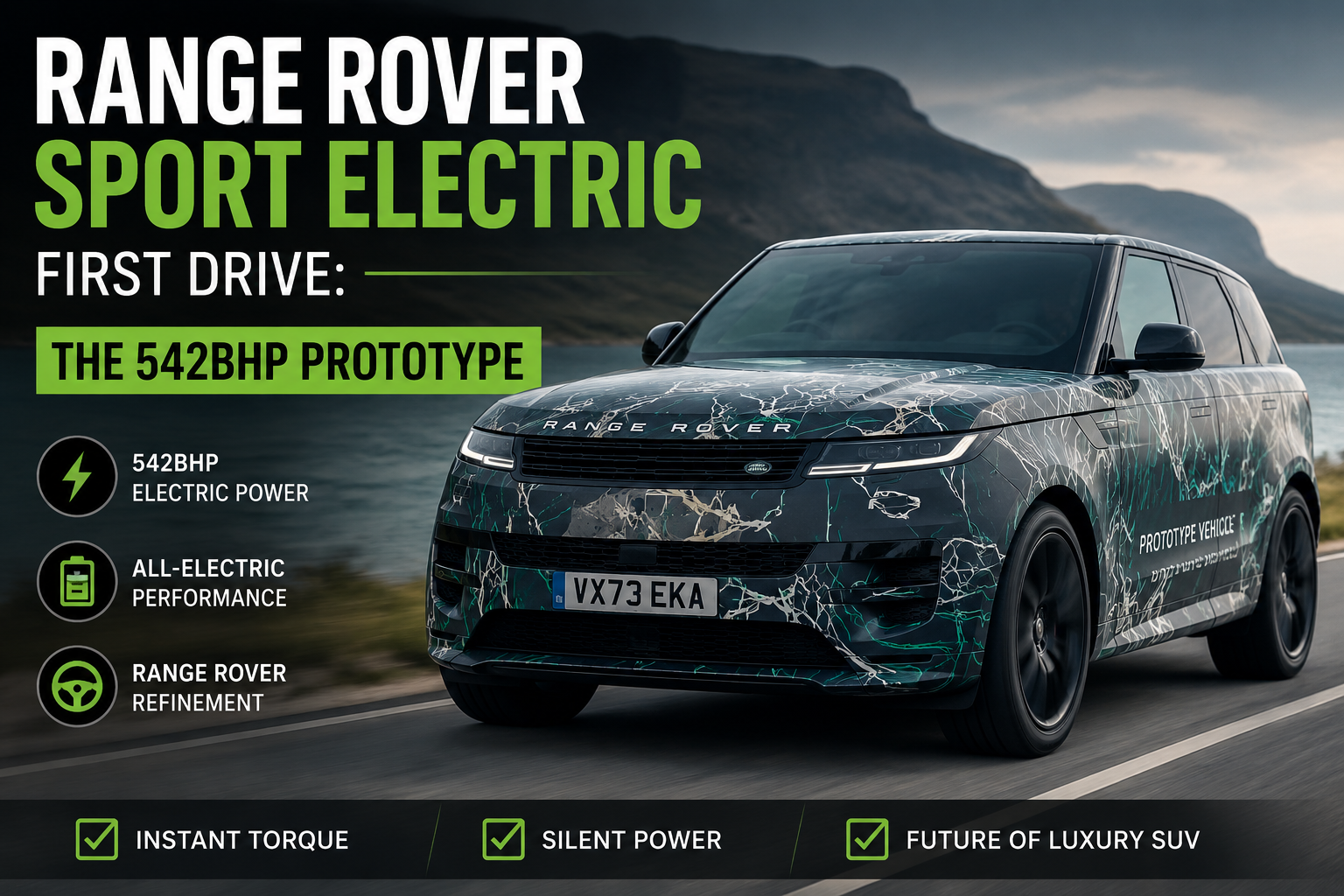
Introduction: Worth the Wait?
The Range Rover Sport Electric was originally slated to arrive back in 2024. Two years later than promised, Jaguar Land Rover has finally let journalists behind the wheel of an early prototype — and after a short but revealing session at the Goodwood Motor Circuit, it’s becoming clear why the automaker chose patience over a rushed launch.
This isn’t JLR’s first crack at an electric Range Rover. The full-size Range Rover Electric has already done winter testing in the Arctic Circle and demonstrated impressive dynamic ability at Goodwood. The Sport Electric is the smaller, sportier sibling — and according to Managing Director Martin Limpert, the two models are being deliberately positioned to feel distinct from one another rather than simply scaled versions of the same car.
What’s Under the Skin?
While full specifications remain under wraps ahead of the official reveal, JLR has confirmed several key details that shed light on what buyers can expect:
- Power: Two electric motors driving all four wheels, producing a combined output believed to be around 542bhp
- Torque: Likely to mirror the full-size Range Rover Electric’s substantial output
- Battery: A 118.5kWh usable double-stack battery pack, shared with its bigger sibling
- Architecture: An 800-volt electrical system enabling rapid DC charging
- Estimated Range: Roughly 330 miles on a full charge, though official figures haven’t been confirmed
That battery and motor setup is shared with the flagship Range Rover Electric, which makes sense given both models sit on a common platform. It’s a strategy that should keep development costs in check while still delivering genuine performance credentials.
How Does It Drive?
Behind the wheel — even for a brief 15-minute stint — the transformation from combustion to electric power feels like a natural fit for the Range Rover Sport’s character rather than a compromise.
On-Road Dynamics: Through a cone slalom designed to test the car’s Dynamic drive mode, the Sport Electric felt notably agile for its size. With the battery pack mounted low in the floor, the center of gravity sits well below that of the combustion-engined versions, helping the SUV stay composed and flat through quick direction changes. Dynamic mode sharpens the throttle response for noticeably punchier acceleration, though official 0-60mph figures haven’t been released yet.
One-Pedal Driving: All Sport Electric models come with a high-regeneration driving mode that lets you slow and stop using just the accelerator. The brake pedal itself blends into friction braking so seamlessly that the transition is barely noticeable — a hallmark of a well-sorted EV powertrain rather than an early-stage prototype.
Off-Road Capability: True to Range Rover tradition, the electric powertrain hasn’t dulled the Sport’s off-road chops. A Rock Crawl mode allowed the prototype to climb a steep set of steps with minimal wheel slip, and the approach and departure angles remain impressive. All the familiar off-road drive modes carry over, each recalibrated to work seamlessly with the single-pedal driving system.
Interior and Technology
Climb inside and the changes are subtle rather than dramatic. The cabin features a 13.1-inch central touchscreen and a 13.7-inch digital instrument display, but otherwise mirrors the clean, minimalist design of every post-2024 Range Rover Sport. Even the drive selector carries over largely unchanged — though the “S” position, once reserved for the transmission’s Sport mode, now activates single-pedal drive.
Refinement appears to be a strong suit already. Wind and road noise insulation feels excellent even at this early prototype stage, reinforcing the sense that the electric powertrain suits the model’s premium, hushed character.
Why Did JLR Take So Long?
The delay makes more sense once you consider what JLR is trying to achieve. Rather than rushing an EV to market to chase early adopters, the brand appears focused on making sure the Sport Electric matches — or exceeds — the refinement, capability, and desirability of its combustion-engined counterparts. Given how integrated the electric powertrain already feels with the SUV’s suspension, steering, and off-road systems at this early stage, that extra development time looks to be paying off.
Competitors like the Porsche Cayenne Electric are setting a high bar for range and charging speed in this segment, and JLR will need the Sport Electric to be competitive on both fronts to justify its premium positioning.
Pricing and Availability
JLR hasn’t confirmed pricing yet, but expect the Sport Electric to sit above the range-topping combustion models, which currently start just under £80,000. A single battery and motor configuration is expected at launch, with full details and an official unveiling anticipated later this year.
Final Thoughts
Based on this early taste, the Range Rover Sport Electric looks like it could be one of the most compelling EVs in the luxury SUV space — combining genuine off-road ability, a refined and quiet cabin, and strong on-road dynamics. The real questions around real-world range, charging speed, and pricing remain unanswered for now, but if this prototype is anything to go by, JLR’s patience may well have been justified.