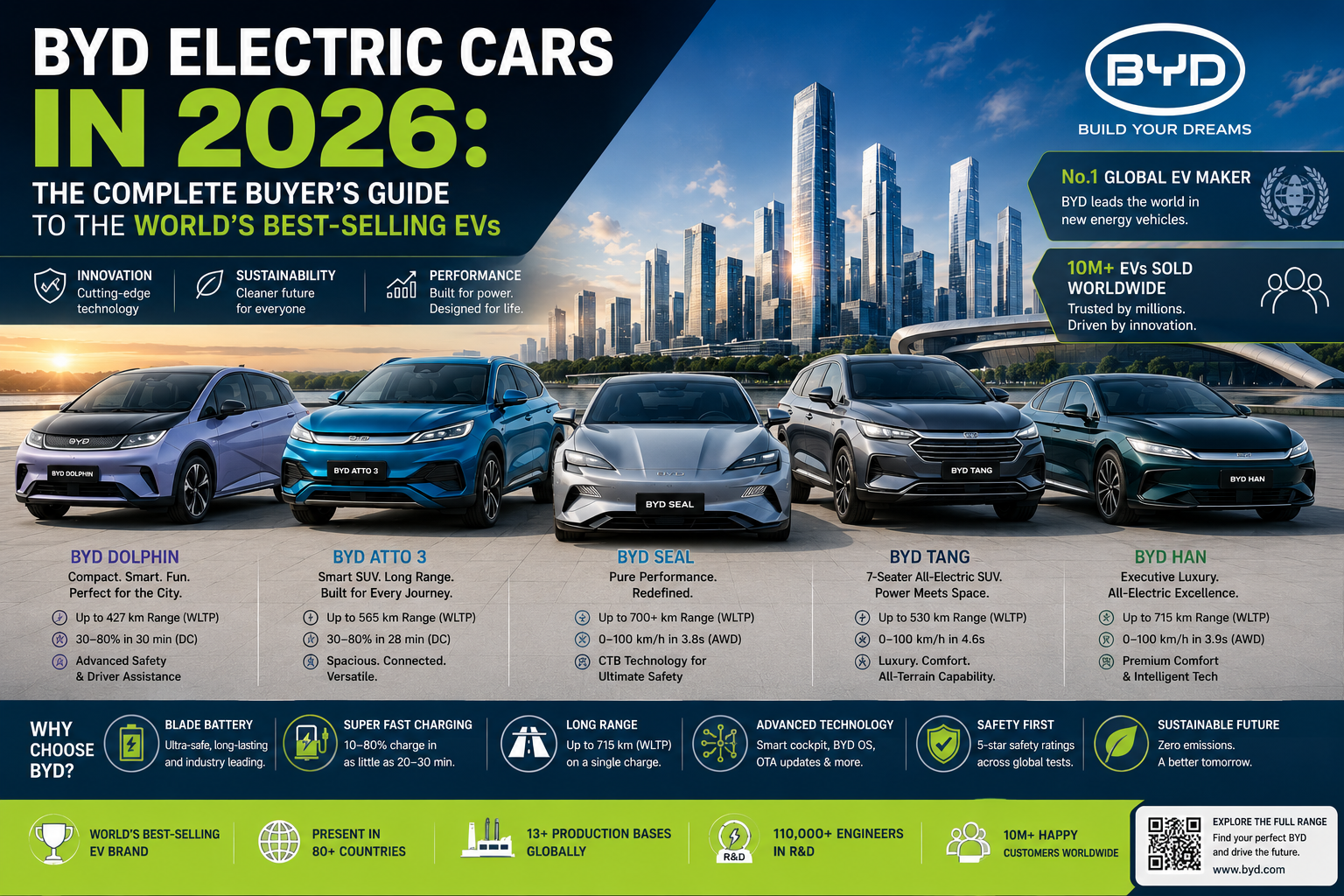
Why Everyone Is Suddenly Talking About BYD
A decade ago, BYD was a name most car buyers outside China had never heard of. Today, it’s the brand every automaker watches nervously in the rearview mirror. Since diversifying into cars back in 2003 after building its name in lithium-ion batteries, BYD has surged into the global spotlight — and the company has become the world’s leading manufacturer of electric vehicles, surpassing Tesla in sales volume since 2024.
So what’s actually driving that growth? It comes down to three things: aggressive pricing, genuinely competitive technology, and a lineup that covers almost every segment a buyer could want — from city runabouts to luxury SUVs. Let’s break down what BYD’s 2026 electric range actually looks like, and whether it deserves a spot on your shortlist.
The Technology Behind the Hype: Blade Battery
BYD’s biggest advantage over legacy automakers isn’t styling — it’s chemistry. The company’s proprietary Blade Battery is a lithium iron phosphate (LFP) design that’s earned a reputation as safer and longer-lasting than the nickel-based batteries used by many rivals. Newer models are now shipping with a second-generation version of the tech paired with ultra-fast flash charging, with BYD claiming a jump from 10% to 70% charge in roughly five minutes on its latest platforms.
That battery expertise, built over more than 30 years, is a big reason BYD can undercut European and American competitors on price without cutting corners on safety — its EVs have consistently scored 5 stars in Euro NCAP crash testing.
BYD’s 2026 Electric Lineup
Dolphin Surf — The Affordable City Car
BYD’s entry point into electric ownership, the Dolphin Surf is designed for buyers who want an EV without the premium price tag. It starts at a strikingly low price point in European markets and is built for urban commuting rather than long-distance touring — think easy parking, tight turning circles, and low running costs.
Atto 3 Evo — The Compact SUV Reboot
The Atto 3 has been BYD’s volume seller in international markets, and the 2026 Evo update makes it far more competitive. It now rides on BYD’s 800-volt e-Platform 3.0, bringing rapid 220kW DC charging and a WLTP range of up to roughly 510 km — a genuine leap over the outgoing model. If you’re cross-shopping compact electric SUVs, this is the version worth waiting for rather than settling for older stock.
Seal — The Sedan That Punches Above Its Price
The Seal is arguably BYD’s halo product for image-conscious buyers. It’s positioned to go head-to-head with the Tesla Model 3 and Volkswagen ID.7, offering near-luxury build quality, brisk performance (0–60 mph in under 4 seconds in higher trims), and range up to roughly 354 miles — all at a price that undercuts established premium brands. BYD has also expanded the family with newer variants like the Seal 06 GT, which layers in the second-generation Blade Battery and flash-charging tech to court younger buyers worried about range anxiety.
Tang — The Family-Friendly 7-Seater
For buyers who need three rows, the Tang is BYD’s flagship SUV, blending long-distance comfort with the brand’s now-signature safety and battery tech. It’s the practical choice for families who still want to go fully electric.
Atto 2 — Filling the Gap Below Atto 3
BYD recently rounded out its SUV range with the smaller, more affordable Atto 2, aimed at buyers who want SUV proportions and equipment without stepping up to Atto 3 pricing. It arrives well-equipped as standard, targeting drivers who want a “big-car” feel in a compact footprint.
What Actually Sets BYD Apart From the Competition
1. Price-to-performance ratio. BYD consistently prices its EVs below equivalent European and American models while matching — or beating — them on range, charging speed, and standard equipment.
2. Vertical integration. Because BYD manufactures its own batteries, chips, and even semiconductors, it has more control over cost and supply chain than automakers who outsource these components. That’s a major reason it can move fast on price cuts and new tech rollouts.
3. Warranty confidence. BYD backs its vehicles with a 6-year/150,000 km vehicle warranty, an 8-year/250,000 km battery warranty (guaranteeing a minimum of 70% capacity retention), an 8-year/150,000 km powertrain warranty, and 12 years of corrosion protection with no mileage cap — terms that apply even retroactively to vehicles already sold. That’s a strong statement of confidence from a manufacturer that’s still relatively new to Western markets.
4. Rapid model cycles. Where legacy automakers might refresh a model every five to seven years, BYD is iterating fast — new variants, updated batteries, and expanded trims are landing multiple times a year.
Where BYD Still Has Ground to Cover
No lineup is perfect, and it’s worth going in with clear eyes:
- Brand newness in Western markets. BYD only entered markets like the UK in late 2022/early 2023, so long-term reliability data is still limited compared to established brands.
- Charging network dependency. In regions without dense fast-charging infrastructure, BYD’s rapid-charging advantages are harder to fully exploit.
- Resale value uncertainty. As a newer entrant in many markets, resale values are still being established — though this can also work in buyers’ favor, since some models depreciate quickly enough to make excellent value used purchases.
Which BYD Should You Actually Buy?
- Want the cheapest way into an EV? Go with the Dolphin Surf.
- Need a practical compact SUV with the latest tech? Wait for the Atto 3 Evo.
- Want a head-turning sedan that rivals premium brands? The Seal is your best bet — and an excellent used buy given early depreciation.
- Have a family and need three rows? The Tang is built for you.
- Want SUV looks on a smaller budget? Check out the Atto 2.
The Bottom Line
BYD isn’t a budget alternative to “real” EV brands anymore — it’s setting the pace.
With category-leading battery tech, aggressive pricing, and a lineup expanding faster than almost any competitor, BYD has legitimately earned its position as the world’s best-selling EV maker. If you’re cross-shopping electric cars in 2026, it would be a mistake to leave BYD off your list.
Have questions about a specific BYD model or how it compares to a competitor? Drop them in the comments — I’ll help you figure out the right fit.