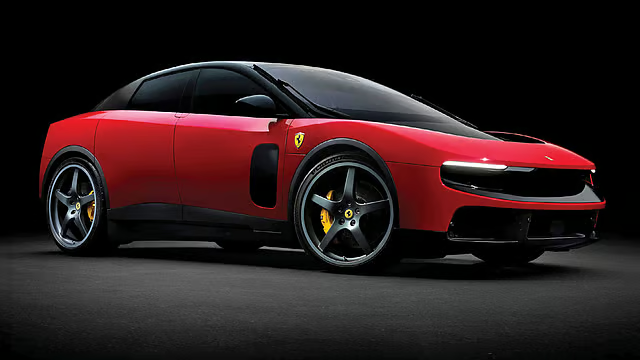
Ferrari’s first EV doesn’t creep in quietly. The Ferrari Luce lands with 1,035 horsepower, four motors, and a cabin that pushes back against the giant-screen trend.
That alone would make it big news. The timing matters too, because premium brands are still testing demand for electric exotics, and Lamborghini already shelved its Lanzador grand tourer. The Luce has to do more than go fast, it has to prove a supercar brand can make an EV people want to live with.
The Ferrari Luce looks unlike any other Ferrari
The Luce is a four-door liftback, and its shape feels more like a sleek glass house than a classic mid-engine Ferrari. Coach doors swing wide, the rear keeps circular taillights as a small nod to the past, and nearly everything else points forward. Up front, a large air channel cuts through the body, while the windshield wipers sit at the sides instead of the cowl. Air also passes through a floating rear wing. Ferrari says that makes the Luce its most aerodynamic road car yet.
That new shape won’t please every Ferrari loyalist, and the company knows it. Still, there is a clear reason for the break with tradition. The Luce is meant to be the easiest Ferrari to use every day, with five seats, a 21-cubic-foot trunk, and a price around 550,000 euros when European sales start later this year. It’s also Ferrari’s first five-seater, which tells you this car is aimed at buyers who want theater and usefulness in the same package.
Four motors, 1,035 hp, and an 800-volt platform
Under the skin, the Luce uses a dedicated EV platform with a cast-and-extruded aluminum chassis and a structural battery built into the floor. Total weight stays just under 5,000 pounds, and Ferrari says the balance is 47/53 front to rear. You can browse the official Ferrari Luce specs for the full factory overview.
The headline numbers are easy to scan:
| Spec | Ferrari Luce |
|---|---|
| Power | 1,035 hp |
| Torque | 730 lb-ft |
| Battery | 122 kWh |
| Voltage | 800 V |
| DC fast charging | Up to 350 kW |
| 0-62 mph | 2.5 seconds |
| Top speed | 192 mph |
| Range | 530 km WLTP |
Those numbers put the Luce in rare air, yet Ferrari made a few unusual choices. Each wheel has its own permanent-magnet motor, the front pair can spin to 30,000 rpm, and the front axle can disconnect for better cruise efficiency. The 122 kWh pack uses SK On pouch cells in 15 modules, and Ferrari says owners will be able to swap in future battery modules as the car ages. If you want more context on how pack design shapes power and range, this guide to modern EV battery pack trends helps.
Range is the one place where the Luce feels less dominant. Ferrari estimates 530 km on the WLTP cycle, which likely lands around 250 to 300 miles by EPA standards. That’s solid, not class-leading, especially at this price. Ferrari’s answer is simple: it tuned the car for feel first, with F80-derived active suspension, rear-wheel steering, and torque vectoring at both axles. The company says that blend of comfort and performance wouldn’t be possible in a combustion car.
Inside, the Luce rejects screen overload
Open the door and the cabin takes a sharp turn away from the Tesla style of car design. There is a touchscreen in the center, but the mood is tactile. The steering wheel is milled from a single piece of aluminum, and it carries solid, clicky controls for driver assistance, drive modes, and wipers.
Behind the wheel sit two paddles with jobs you don’t usually see paired this way. The left paddle adjusts regenerative braking, while the right changes torque output from the motors. Below the center screen, physical climate toggles remain in place, and the screen itself can tilt toward or away from you. Ferrari also added an analog compass that can become a clock, plus a bank of overhead controls that includes the launch-mode trigger.
Sir Jony Ive helped shape the interior, and you can feel that clean influence. Some will call it too sterile. Yet the mix of analog hardware and digital flexibility feels fresh, especially in an era when too many cabins bury basic tasks in menus.
Final thoughts
The Ferrari Luce matters because it doesn’t follow the EV playbook everyone else uses. It bets on drama, tactile controls, and Ferrari-style road manners, even if that means the charging speed and range don’t top every chart.
Whether buyers embrace it is still the open question. If the Luce drives as well as its hardware suggests, Ferrari may have found a way to make an electric car feel like a Ferrari, not a fast appliance.