Introduction
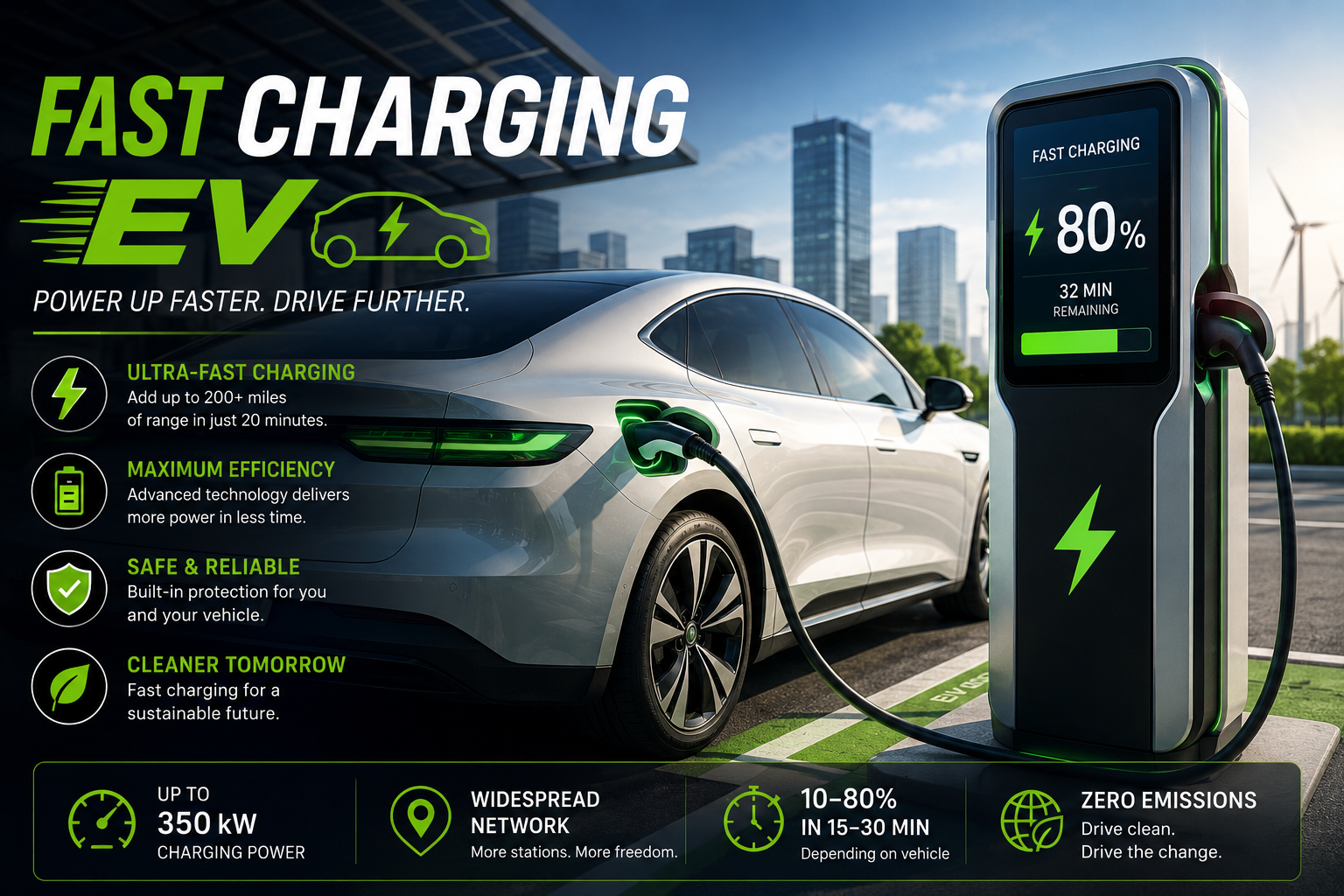
Electric vehicles (EVs) are transforming the way we drive, and one of the biggest factors influencing EV adoption is charging speed. Gone are the days when charging an EV meant waiting eight hours overnight. With fast charging EV technology, drivers can now recharge their vehicles in a fraction of the time, making long road trips and daily commutes far more convenient.
In this guide, we’ll break down what fast charging EV really means, how it works, the different levels of charging, cost considerations, and tips to protect your battery while charging quickly.
What Is Fast Charging EV Technology?
Fast charging EV refers to high-powered charging systems, typically DC (Direct Current) fast chargers, that deliver electricity to an EV’s battery at a much higher rate than standard home chargers. While a typical Level 2 home charger might take 6–8 hours to fully charge a vehicle, a fast charger can bring most EVs from 20% to 80% battery capacity in as little as 20 to 40 minutes.
This speed is achieved because DC fast chargers bypass the vehicle’s onboard AC-to-DC converter and feed power directly into the battery, significantly reducing charging time.
Levels of EV Charging Explained
Understanding the different charging levels helps clarify why fast charging stands out.
Level 1 Charging
- Uses a standard 120V household outlet
- Adds roughly 3–5 miles of range per hour
- Best suited for overnight charging with minimal daily driving
Level 2 Charging
- Uses a 240V outlet, similar to what powers a home dryer
- Adds 15–30 miles of range per hour
- Common in homes, workplaces, and public parking areas
DC Fast Charging (Level 3)
- Delivers power directly as direct current
- Adds 60–200+ miles of range in just 15–20 minutes
- Found along highways, at dedicated charging stations, and in urban hubs
How Fast Charging Works Under the Hood
Fast charging stations convert AC power from the grid into DC power before sending it to the vehicle. Because the conversion happens at the station rather than inside the car, much higher voltages and currents can be used safely and efficiently.
Most fast chargers operate at power levels between 50 kW and 350 kW, depending on the charging network and vehicle compatibility. Newer ultra-fast chargers, often called “hypercharge” stations, can exceed 350 kW, cutting charging times down even further for compatible vehicles.
Popular Fast Charging Standards
Different manufacturers and regions use different fast charging connectors:
- CCS (Combined Charging System): Widely used across North America and Europe
- CHAdeMO: Common in older Japanese EV models
- NACS (North American Charging Standard): Tesla’s connector, increasingly adopted by other automakers
- GB/T: Used primarily in China
Knowing which standard your EV supports is essential before relying on a public fast charging network.
Benefits of Fast Charging EV Stations
- Time Efficiency – Significantly reduces downtime during long trips.
- Convenience for Road Trips – Makes cross-country EV travel practical.
- Growing Infrastructure – More fast charging stations are being built along highways and in cities every year.
- Improved EV Adoption – Reduces range anxiety, encouraging more drivers to switch to electric.
Things to Consider Before Using Fast Chargers
While fast charging offers speed and convenience, there are a few important factors to keep in mind:
Battery Health
Frequent use of fast charging can generate more heat, which, over time, may contribute to slightly faster battery degradation compared to slower home charging. Most manufacturers recommend using fast charging occasionally rather than as your sole charging method.
Charging Curve
EV batteries don’t charge at a constant speed. Charging is fastest between 10% and 80%, then slows significantly to protect the battery. This is why most fast charging sessions are optimized to stop around 80%.
Cost Differences
Fast charging typically costs more per kWh than home charging due to the infrastructure and energy demands involved. Prices vary by network, location, and membership plans.
Tips to Maximize Fast Charging Efficiency
- Precondition your battery before arriving at a fast charger, especially in cold weather
- Charge to 80% rather than 100% for daily fast charging needs
- Use fast charging primarily for long trips, not daily routines
- Choose reputable charging networks with reliable uptime and support
The Future of Fast Charging EV Technology
As battery chemistry advances and charging infrastructure expands, fast charging speeds continue to improve. Innovations such as solid-state batteries, higher-voltage architectures (800V+), and ultra-fast 350 kW+ chargers are paving the way for EVs that can charge in under 15 minutes — rivaling the time it takes to refuel a gasoline vehicle.
Frequently Asked Questions
Q: How long does it take to fast charge an EV? Most EVs can charge from 20% to 80% in 20–40 minutes using a DC fast charger, depending on the vehicle and charger power output.
Q: Is fast charging bad for my EV battery? Occasional fast charging is generally safe. However, relying on it exclusively may contribute to faster battery wear over time compared to standard home charging.
Q: Can every EV use fast charging stations? Not all EVs support the same charging standards or power levels, so it’s important to check compatibility with your vehicle’s charging port and specifications.
Q: Is fast charging more expensive than home charging? Yes, fast charging usually costs more per kWh due to higher infrastructure and operational costs at public stations.
Conclusion
Fast charging EV technology is a game-changer for electric vehicle owners, offering the speed and convenience needed to make EVs a practical choice for everyday driving and long-distance travel. By understanding how fast charging works, choosing the right stations, and following best practices for battery health, drivers can enjoy a seamless and efficient charging experience.
Whether you’re new to EVs or a seasoned electric vehicle owner, staying informed about fast charging advancements ensures you get the most out of your driving experience — saving time, money, and hassle on the road.
1 thought on “Fast Charging EV: The Complete Guide to Quick and Efficient Electric Vehicle Charging”