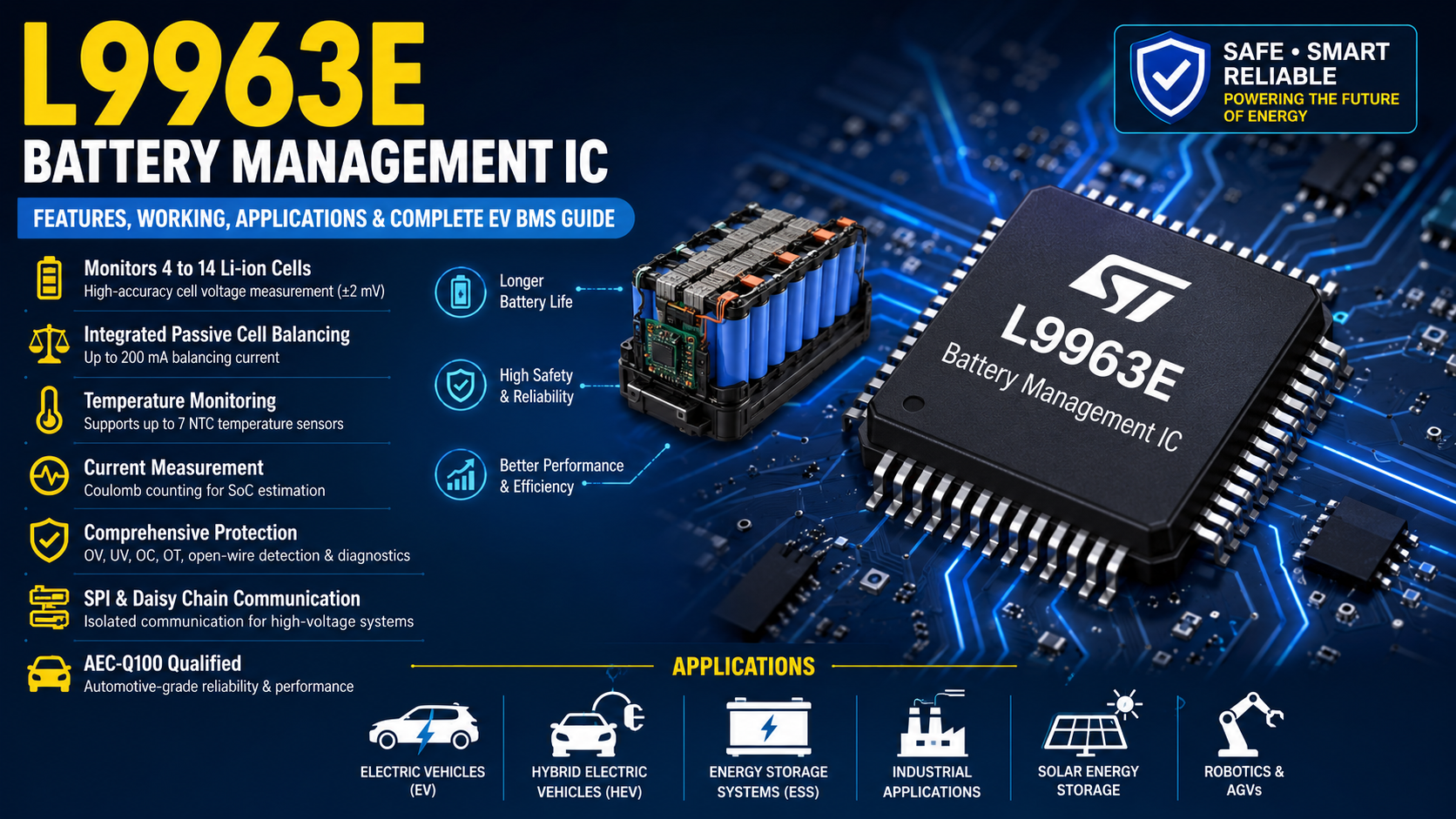
The rapid growth of electric vehicles (EVs), battery energy storage systems (BESS), and hybrid electric vehicles (HEVs) has increased the demand for intelligent battery management solutions. Among the most advanced battery monitoring integrated circuits available today, the L9963E Battery Management IC stands out for its exceptional accuracy, reliability, and automotive-grade safety features.
Developed by STMicroelectronics, the L9963E is designed to monitor lithium-ion battery cells, protect battery packs from unsafe operating conditions, and improve battery lifespan through intelligent cell balancing and diagnostics.
Whether you are designing an EV battery pack, an industrial energy storage system, or researching battery management technology, this guide explains everything you need to know about the L9963E Battery Management IC in 2026.
What Is the L9963E Battery Management IC?
The L9963E Battery Management IC is a high-performance battery monitoring and management integrated circuit developed specifically for automotive and industrial battery applications.
Instead of functioning as a battery charger, the L9963E acts as the “health monitor” of a battery pack. It continuously measures:
- Individual cell voltage
- Battery current
- Cell temperature
- Fault conditions
- Battery balancing status
This information is sent to a Battery Management System (BMS) controller, which makes intelligent decisions about charging, discharging, and overall battery protection.
Why Is Battery Management Important?
Lithium-ion batteries are highly efficient but require continuous monitoring to ensure safe and reliable operation.
Without a Battery Management System, batteries may experience:
- Cell overcharging
- Deep discharge
- Thermal runaway
- Capacity imbalance
- Reduced battery life
- Fire hazards
- Performance degradation
The L9963E helps prevent these issues by continuously monitoring battery health and taking protective actions when abnormal conditions are detected.
Key Features of the L9963E Battery Management IC
The L9963E combines advanced battery monitoring capabilities with automotive-grade reliability.
1. Monitors Multiple Battery Cells
The IC supports monitoring of 4 to 14 lithium-ion battery cells connected in series, making it suitable for:
- Electric vehicles
- Hybrid vehicles
- Energy storage systems
- Industrial battery packs
2. High-Precision Voltage Measurement
One of the biggest strengths of the L9963E is its high measurement accuracy.
Typical voltage accuracy reaches ±2 mV, enabling:
- Accurate State of Charge (SoC)
- Better battery balancing
- Longer battery life
- Improved charging efficiency
3. Integrated Passive Cell Balancing
Battery cells naturally become unbalanced after repeated charging and discharging cycles.
The L9963E includes built-in passive balancing that:
- Equalizes cell voltages
- Prevents overcharged cells
- Maximizes usable battery capacity
- Extends battery lifespan
4. Temperature Monitoring
Battery temperature directly affects safety and performance.
The L9963E supports multiple NTC temperature sensors to monitor:
- Cell temperature
- Module temperature
- Ambient temperature
If overheating is detected, the BMS can immediately reduce charging current or disconnect the battery.
5. Coulomb Counting
The IC includes current measurement functionality used for Coulomb Counting.
This allows the Battery Management System to accurately estimate:
- State of Charge (SoC)
- Remaining battery capacity
- Available driving range
- Charge/discharge efficiency
6. Comprehensive Safety Protection
Safety is one of the main reasons automotive manufacturers choose the L9963E.
It provides protection against:
- Overvoltage
- Undervoltage
- Overtemperature
- Open-wire faults
- Communication failures
- Diagnostic errors
7. Automotive-Grade Reliability
The L9963E complies with automotive quality standards and is designed for demanding environments, including:
- High temperatures
- Vehicle vibration
- Electrical noise
- Long operating life
How Does the L9963E Work?
The L9963E acts as the sensing and monitoring layer within a Battery Management System.
Step 1: Battery Monitoring
The IC continuously measures:
- Cell voltage
- Battery current
- Temperature
↓
Step 2: Data Processing
Measurement data is digitized using high-resolution ADCs.
↓
Step 3: Fault Detection
The IC checks for:
- Voltage imbalance
- Overheating
- Open-wire conditions
- Communication errors
↓
Step 4: Communication
All battery information is transmitted to the main microcontroller through SPI communication.
↓
Step 5: Battery Protection
The BMS controller decides whether to:
- Continue charging
- Stop charging
- Balance cells
- Disconnect the battery
- Issue fault warnings
Typical L9963E Battery Management Architecture
Battery Cells
      │
      ▼
L9963E Battery Monitor
      │
      ▼
SPI Communication
      │
      ▼
Microcontroller (BMS Controller)
      │
      ▼
Battery Protection Algorithms
      │
      ▼
Motor Controller / Charger / Vehicle ECU
Main Specifications
| Specification | Details |
|---|---|
| Cell Support | 4–14 Li-ion cells |
| Voltage Accuracy | ±2 mV Typical |
| Communication | SPI |
| Cell Balancing | Passive Balancing |
| Temperature Monitoring | Multiple NTC Inputs |
| Current Measurement | Coulomb Counting |
| Fault Detection | Integrated |
| Automotive Qualification | AEC-Q100 |
| Applications | EV, HEV, ESS, Industrial |
Advantages of the L9963E Battery Management IC
The L9963E offers several advantages over conventional battery monitoring solutions:
- Excellent voltage measurement accuracy
- Built-in cell balancing
- Comprehensive diagnostics
- Reduced external component count
- High reliability
- Improved battery lifespan
- Faster fault detection
- Better battery utilization
- Automotive-grade safety
- Scalable for high-voltage battery packs
Applications
The L9963E is suitable for a wide range of battery-powered systems, including:
Electric Vehicles (EVs)
Modern electric cars require continuous battery monitoring to maximize safety, efficiency, and driving range.
Hybrid Electric Vehicles (HEVs)
The IC manages battery packs used alongside internal combustion engines.
Battery Energy Storage Systems (BESS)
Large-scale energy storage installations use battery monitoring to improve reliability and extend service life.
Industrial Equipment
Battery-powered industrial machinery benefits from accurate monitoring and diagnostics.
Solar Energy Storage
Residential and commercial solar battery systems use BMS technology to protect valuable energy storage assets.
Robotics and Automated Guided Vehicles (AGVs)
Industrial robots and AGVs rely on intelligent battery monitoring for uninterrupted operation.
L9963E vs Traditional Battery Monitoring ICs
| Feature | L9963E | Conventional IC |
| High Accuracy | ✔ | Limited |
| Cell Balancing | ✔ | Sometimes |
| Temperature Monitoring | ✔ | Basic |
| Automotive Qualified | ✔ | Not Always |
| Fault Diagnostics | Advanced | Limited |
| EV Ready | ✔ | Limited |
| Long Battery Life | Excellent | Moderate |
Why EV Manufacturers Prefer the L9963E
Battery performance directly influences an electric vehicle’s safety, range, and reliability. The L9963E helps manufacturers:
- Improve battery pack efficiency
- Extend battery lifespan
- Enhance passenger safety
- Reduce maintenance costs
- Support predictive diagnostics
- Meet stringent automotive quality requirements
As EV battery capacities continue to grow, advanced monitoring ICs such as the L9963E play an increasingly important role in ensuring consistent performance throughout the battery’s service life.
Future of Battery Management Systems in 2026
Battery Management Systems are evolving rapidly with advancements in artificial intelligence, cloud connectivity, and predictive analytics. Future BMS platforms will increasingly support:
- AI-driven battery health prediction
- Real-time remote diagnostics
- Digital twin battery modeling
- Over-the-air firmware updates
- Smart charging optimization
- Vehicle-to-Grid (V2G) integration
- Enhanced cybersecurity for connected battery systems
High-precision monitoring ICs like the L9963E provide the accurate data needed to enable these next-generation capabilities.
Frequently Asked Questions (FAQ)
What is the L9963E Battery Management IC?
The L9963E is an automotive-grade battery monitoring IC designed to measure cell voltage, current, and temperature while providing protection and balancing for lithium-ion battery packs.
How many battery cells can the L9963E monitor?
It supports monitoring 4 to 14 lithium-ion cells connected in series.
Does the L9963E support cell balancing?
Yes. The IC includes integrated passive cell balancing to help equalize cell voltages and improve battery performance.
Is the L9963E suitable for electric vehicles?
Yes. It is specifically designed for EVs, HEVs, battery energy storage systems, and other high-reliability battery applications.
Why is accurate battery monitoring important?
Accurate monitoring helps improve safety, optimize charging, extend battery life, increase energy efficiency, and detect faults before they become critical.
Final Thoughts
The L9963E Battery Management IC is a powerful solution for modern lithium-ion battery monitoring, combining high measurement accuracy, integrated balancing, robust diagnostics, and automotive-grade reliability. As electric mobility and energy storage continue to expand in 2026, components like the L9963E will play a key role in enabling safer, more efficient, and longer-lasting battery systems.
Whether you are an engineer developing an EV battery pack, a student learning about Battery Management Systems, or an industrial automation professional exploring advanced battery technologies, understanding the capabilities of the L9963E provides valuable insight into the future of intelligent energy management.