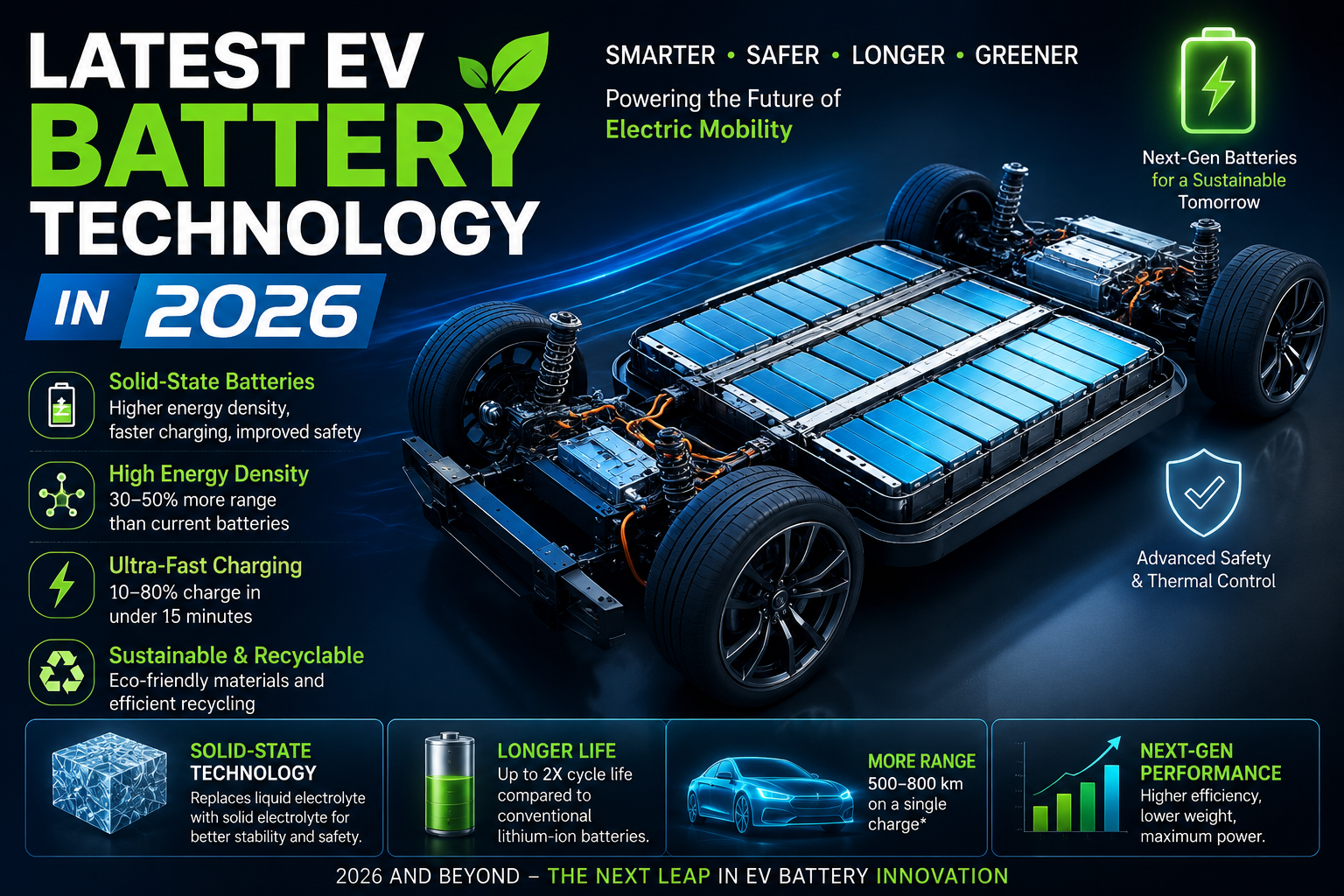
Latest EV Battery Technology in 2026
Electric vehicles (EVs) are transforming the global transportation industry, and battery innovation is driving this revolution. Modern EV batteries are becoming safer, faster to charge, longer-lasting, and more affordable than ever before. In 2026, several breakthrough battery technologies are moving from research labs to commercial production, promising a new generation of electric vehicles with improved performance and lower ownership costs.
In this guide, we’ll explore the latest EV battery technologies, their advantages, challenges, and what they mean for the future of electric mobility.
Why EV Battery Technology Matters
The battery is the heart of every electric vehicle. It directly affects:
- Driving range
- Charging speed
- Vehicle performance
- Battery lifespan
- Safety
- Purchase price
- Environmental impact
Manufacturers are investing billions of dollars to develop batteries that deliver greater efficiency while reducing dependence on expensive materials such as lithium, cobalt, and nickel.
1. Solid-State Batteries
Solid-state batteries are considered the biggest breakthrough in EV battery technology.
Unlike traditional lithium-ion batteries that use liquid electrolytes, solid-state batteries use a solid electrolyte.
Benefits
- Up to 50% higher energy density
- Longer driving range
- Faster charging times
- Lower fire risk
- Longer battery lifespan
- Better performance in extreme temperatures
Challenges
- High production costs
- Complex manufacturing
- Limited large-scale production
Many automakers expect commercial deployment of solid-state batteries in premium electric vehicles during the coming years.
2. Sodium-Ion Batteries
Sodium-ion batteries are becoming a cost-effective alternative to lithium-ion batteries.
Since sodium is abundant and inexpensive, these batteries can significantly reduce EV manufacturing costs.
Advantages
- Lower production cost
- Improved cold-weather performance
- Excellent thermal safety
- Environmentally friendly
- Reduced dependence on lithium
Disadvantages
- Lower energy density
- Slightly shorter driving range
Sodium-ion batteries are particularly suitable for affordable city EVs, compact SUVs, and electric two-wheelers.
3. Silicon-Anode Batteries
Traditional lithium-ion batteries use graphite anodes.
Silicon-anode technology replaces much of the graphite with silicon, allowing the battery to store significantly more energy.
Key Benefits
- Higher battery capacity
- Faster charging
- Increased vehicle range
- Better energy efficiency
Several leading battery manufacturers are already integrating silicon into commercial battery cells.
4. Lithium Manganese Rich (LMR) Batteries
LMR batteries are emerging as one of the most promising next-generation battery chemistries.
They reduce the need for expensive cobalt while maintaining high energy density.
Benefits
- Longer driving range
- Lower manufacturing cost
- Improved sustainability
- Better thermal stability
LMR batteries are expected to power future long-range electric vehicles.
5. Semi-Solid-State Batteries
Semi-solid-state batteries combine liquid and solid electrolytes.
They provide many advantages of solid-state batteries while remaining easier and cheaper to manufacture.
Advantages
- Higher safety
- Faster charging
- Better energy density
- Improved reliability
Several manufacturers have already introduced EVs using semi-solid-state battery technology.
Fast-Charging Technology
Battery chemistry is only one part of the EV revolution.
Modern charging innovations now include:
- 800V battery architecture
- Ultra-fast DC charging
- Intelligent battery cooling
- AI-powered battery management systems (BMS)
- Bidirectional charging (Vehicle-to-Home and Vehicle-to-Grid)
These technologies allow many modern EVs to recharge from 10% to 80% in around 20 minutes under ideal conditions.
Battery Recycling and Sustainability
As EV adoption grows, battery recycling has become increasingly important.
Modern recycling technologies can recover valuable materials such as:
- Lithium
- Nickel
- Cobalt
- Copper
- Aluminum
Recycling reduces mining demand, lowers production costs, and minimizes environmental impact.
Which EV Battery Technology Is Best?
There is no single “best” battery technology. Each serves different needs.
| Battery Type | Range | Charging | Safety | Cost | Best For |
|---|---|---|---|---|---|
| Solid-State | Excellent | Excellent | Excellent | High | Premium EVs |
| Sodium-Ion | Moderate | Good | Excellent | Low | Budget EVs |
| Silicon-Anode | Very Good | Excellent | Good | Medium | Performance EVs |
| LMR | Excellent | Good | Very Good | Medium | Long-range EVs |
| Lithium-Ion (LFP/NMC) | Good | Good | Good | Medium | Today’s mainstream EVs |
The Future of EV Batteries
By 2030, electric vehicles are expected to feature:
- Charging times under 10 minutes
- Driving ranges exceeding 1,000 km
- Longer battery life with thousands of charge cycles
- Lower battery costs
- Reduced use of rare materials
- Higher recycling rates
These innovations will make EVs more affordable, practical, and sustainable for millions of drivers worldwide.
Final Thoughts
Battery technology is evolving faster than ever. Solid-state, sodium-ion, silicon-anode, and LMR batteries each offer unique advantages and will shape the next generation of electric vehicles.
As manufacturing scales up and costs decrease, consumers can expect EVs with longer ranges, faster charging, greater safety, and lower ownership costs. The future of electric mobility is being built today, and advanced battery technology is at the center of this transformation.
1 thought on “Latest EV Battery Technology in 2026: Solid-State, Sodium-Ion and Beyond”