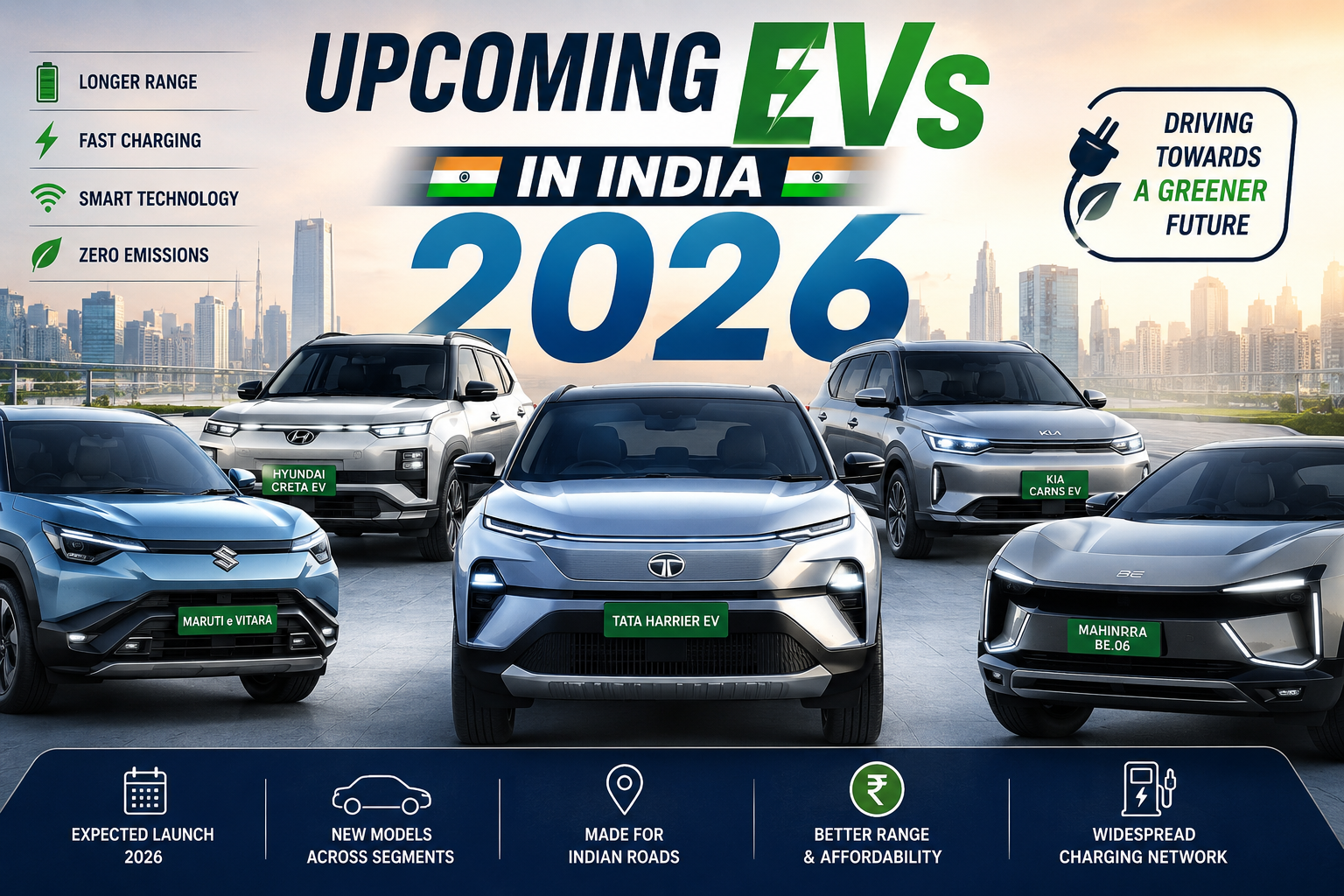
If you’re thinking about buying an EV in India, 2026 is shaping up to be the year that could make waiting feel smart. More models are on the way, ranges are climbing, and price bands are spreading out in a way Indian buyers haven’t seen before.
Tata, Mahindra, MG, Kia, and a new entrant from the JSW group all have big plans. Some of these are pure EVs, some are plug-in hybrids, and most of them target a different kind of buyer. Before you put money down on a car today, it’s worth seeing what the next few months may bring.
Why 2026 could be the best year yet to buy an EV in India
The big reason to pause is simple: choice. Until recently, the EV market in India had clear gaps. You could find city-friendly electric hatchbacks and compact SUVs, but it was harder to get a true seven-seater EV, a premium electric sedan, or a plug-in hybrid that eased long-trip worries.
That gap is closing fast. Tata is pushing into midsize, family, and luxury EV space at the same time. MG is widening beyond SUVs and adding its first plug-in hybrid. Kia is preparing what could be a more accessible mass-market EV. JSW, through its partnership with Chery Automobile, wants to arrive with a long-range plug-in hybrid SUV that speaks to buyers who still don’t fully trust public charging for road trips.
The broader future of electric vehicles in India already points in this direction, but 2026 is where that shift starts showing up in showrooms.
This quick table puts the key launches in one place.
| Model | Powertrain | Expected range | Expected price | Expected timing |
|---|---|---|---|---|
| Tata Sierra EV | EV | 500 to 550 km claimed | Rs 20 to 30 lakh | July to September 2026 |
| Tata Safari EV | EV | Not detailed, expected to share Harrier EV tech | Rs 25 to 35 lakh | October to November 2026 |
| Tata Avinya | EV | 500 to 750 km claimed | Rs 40 to 50 lakh | Late 2026 |
| Mahindra BE.07 | EV | About 650 km claimed | Not detailed | Reveal possible in 2026, launch shifted to 2027 |
| MG Starlight 560 EV | EV | Over 500 km expected | Not detailed | July to October 2026 |
| MG Starlight 560 PHEV | Plug-in hybrid | Price shared, range details not fully confirmed beyond hybrid pitch | Rs 20 to 28 lakh | July to October 2026 |
| MG IM5 | EV | Details still emerging | Around Rs 40 lakh | Second half of 2026 |
| JSW T2 | Plug-in hybrid SUV | 1,200 km combined, about 140 km EV-only | Rs 35 to 40 lakh | Around Diwali 2026 |
| Kia Syros EV | EV | About 300 to 400 km real-world | Rs 15 to 20 lakh | July to August 2026 |
The pattern is clear. Buyers are getting more body styles, more price points, and more ways to deal with range anxiety.
More models, more price points, more competition
This wave matters because it isn’t packed into one slice of the market. You have a likely Rs 15 lakh to Rs 20 lakh Kia Syros EV on one side, and a Tata Avinya that wants to enter the luxury conversation on the other. In between sit midsize crossovers, executive sedans, seven-seaters, and plug-in hybrids.
As a result, 2026 looks less like a year of one or two headline launches and more like a year when the market starts to feel mature. Even Hyundai and the German luxury brands, BMW, Mercedes-Benz, and Audi, are part of the wider EV push, though the most detailed plans right now sit with the models covered here.
A recent March 2026 EV sales snapshot also hints at how hard brands are already fighting for position.
What buyers want most in 2026
Range still leads the wish list, but it isn’t the only thing that matters now. Shoppers want fast top-ups, roomy cabins, better screens, ADAS features, and enough space for real family use. They also want less mental math before a long drive.
That is why plug-in hybrids are suddenly more interesting. A car that can run most weekday trips on battery power, then switch to petrol for highway duty, gives many buyers a softer landing into electrification. Meanwhile, pure EVs keep getting stronger where they matter most: daily comfort, low running costs, and smoother drive quality.
Claimed range is useful for comparison, but daily range depends on speed, traffic, air conditioning, passengers, and how much highway driving you do.
Tata’s 2026 EV push: Sierra EV, Safari EV, and Avinya
No brand is attacking more corners of the market at once than Tata. That matters because Tata already has a strong EV base in India, and now it wants to build upward, outward, and more premium at the same time.
The headline act is the Sierra EV, which brings back one of Tata’s most recognizable names in a modern electric form. Then comes the Safari EV, aimed at families who want space without moving to an ICE SUV. Above both sits Avinya, a much more ambitious product that feels like Tata’s attempt to reset how buyers think about Indian premium EVs.
For a wider look at Tata’s pipeline, Autopunditz’s roundup of upcoming Tata EVs tracks the same three names closely.
Sierra EV, the stylish midsize EV to watch
The Sierra EV looks like the most complete package in Tata’s near-term lineup. Expected battery options of 55 kWh and 65 kWh put it in a serious part of the market, and the expected range of 500 to 550 km gives it enough headline strength to grab attention fast.
Tata is also expected to offer both rear-wheel-drive and dual-motor all-wheel-drive versions. If that happens at the predicted price of Rs 20 lakh to Rs 30 lakh, the Sierra EV could land in a sweet spot that very few rivals touch. Inside, the expected triple-screen layout and Level 2 ADAS should help it feel current, not nostalgic.
The design helps too. The Sierra name carries heritage, while the shape leans into a retro-inspired look without feeling old. A reveal is expected by June, with launch timing likely between July and September 2026.
Safari EV, a seven-seater built for big families
The Safari EV may be the most practical Tata launch of the year. A full-size, seven-seater electric SUV is still a rare thing in India, and Tata seems ready to step into that gap during the festive season.
The key detail is that it is expected to share technology with the Harrier EV. That should give it a stronger base than a simple name-extension exercise. Families who want three rows, SUV road presence, and electric running costs will be watching this one closely.
Expected pricing sits around Rs 25 lakh to Rs 35 lakh, with a likely arrival around October or November 2026. If Tata gets the packaging right, the Safari EV could become one of the few EVs that genuinely works as a family-first upgrade.
Avinya, Tata’s premium electric rethink
Avinya is a different kind of Tata project. It isn’t pitched like a conventional midsize SUV or a budget-conscious family car. Instead, it looks like Tata’s premium reset, with a platform derived from Jaguar Land Rover, bigger battery packs, and a cabin-first design.
The expected 80 kWh and 100 kWh battery options are large by Indian standards. Claimed range figures between 500 and 750 km show how high Tata wants to aim here. Add the flat floor, large cabin, and minimalist interior theme, and Avinya starts to sound less like a trimmed-up mainstream EV and more like a serious step into premium territory.
At an expected Rs 40 lakh to Rs 50 lakh, it still sits far below many European luxury EVs. Late 2026 is the expected window. Meanwhile, Tata isn’t ignoring the lower end of the market either, and the Tata Punch EV 2026 review shows how the brand is still sharpening its smaller electric lineup.
Mahindra, MG, and JSW are bringing serious new heat
These three brands tell three different stories. Mahindra is building on its recent EV momentum. MG is stretching into new body styles and powertrains. JSW wants to arrive with something bold enough to pull attention away from the old EV versus petrol debate.
Mahindra BE.07 and the next step after BE 6 and XEV 9e
Mahindra entered this phase with energy, especially after the arrival of the BE 6 and XEV 9e. The BE.07 was originally expected in October 2026, but it has now been pushed to 2027.
That delay doesn’t make it irrelevant. A reveal could still happen before the end of 2026, and the specs being discussed still matter. The BE.07 is expected to be larger than the BE 6, with battery packs up to 80 kWh and a claimed range of about 650 km.
In other words, Mahindra still looks committed to growing upward in size and range. If the company can keep design flair and software polish in place, the BE.07 may become one of 2027’s more important launches, even if its shadow hangs over 2026.
MG’s Starlight 560 and IM5 widen the brand’s reach
MG already has strong EV visibility in India, and the Windsor has helped the brand’s momentum. The next step is broader reach. That starts with the Starlight 560, which is expected in both pure EV and plug-in hybrid forms.
The EV version is expected to offer more than 500 km of range, along with a panoramic sunroof, a 12.8-inch touchscreen, and a premium-feeling cabin. The plug-in hybrid version may be even more important because it opens the door to buyers who like electric driving but still want the backup of a petrol engine. Expected pricing for the plug-in hybrid sits around Rs 20 lakh to Rs 28 lakh, with launch timing between July and October 2026.
Then there is the MG IM5, an electric sedan aimed at executive-car buyers. Details are still limited, but the pitch is clear. MG wants a sleek electric sedan that can challenge the feel of something like a Mercedes CLA Electric while staying far more attainable, at around Rs 40 lakh. A second-half 2026 launch is expected.
JSW T2 and the rise of long-range plug-in hybrids
JSW’s entry is one of the more interesting stories of the year because it adds a new name to the market and a different answer to the charging question. Through its partnership with Chery Automobile, JSW is expected to introduce new brands in India, with the T2 plug-in hybrid SUV as an early attention-grabber.
The reason it stands out is range. The headline number is a claimed 1,200 km of combined range on a full tank and full charge. On battery power alone, the SUV is expected to cover about 140 km. For many people, that could handle the entire weekday commute without using petrol at all.
Then, when the weekend trip comes, the petrol engine takes over and removes the usual charging-stop stress. If the expected Rs 35 lakh to Rs 40 lakh pricing holds, and if the Diwali 2026 launch happens on time, the T2 could attract a very specific kind of buyer: someone who wants electric driving most days but isn’t ready to go full EV yet.
Kia’s Syros EV could be the value EV that changes the market
Kia has usually lived in the premium-but-reachable zone in India. The Syros EV looks like the model that could pull the brand into the heart of the volume EV market.
That shift matters. Most growth in India’s EV space won’t come only from expensive halo cars. It will come from practical models with enough range, strong features, and a price that doesn’t scare away people moving from petrol.
Why the Syros EV matters for budget-conscious buyers
The Syros EV is expected to be Kia’s most affordable electric car in India. That alone makes it important. At a likely Rs 15 lakh to Rs 20 lakh, it goes straight after buyers looking at the Tata Nexon EV and Mahindra XUV 3XO EV.
The styling should stay close to the ICE Syros, with its boxy shape and upright appeal. Kia is expected to add EV-specific touches like a closed grille, aero-friendly wheels, and a charging port on the front fender. Range is expected to land in the 300 km to 400 km real-world zone, which is where many mainstream urban buyers want it to be.
If Kia hits that price band cleanly and launches between July and August 2026, the Syros EV could become one of the year’s most important volume plays.
Features that make it feel more premium than its price
Kia rarely skips cabin tech, and the Syros EV is expected to continue that pattern. The triple-screen layout should help it feel richer than its price suggests, and vehicle-to-load capability means it may be able to power small appliances from the car itself.
ADAS features are also part of the expected package. Local production should help keep the cost in check, which is key because feature-heavy EVs can become expensive fast once buyers start climbing trims.
This mix of price, range, and cabin appeal is what gives the Syros EV its edge. It doesn’t need to be the most powerful EV in the segment. It needs to feel easy to own, easy to live with, and easy to justify.
How to think about range, charging, and total value before you buy
With so many launches coming, the smartest move is to judge these cars by your use case, not by the loudest spec sheet. A 650 km claimed range sounds great, but it may matter less than charging access, family space, or how often you drive between cities.
Start with your week. If most of your driving is short and predictable, a pure EV usually makes the most sense. If your usage swings between city commuting and long highway runs, a plug-in hybrid may fit better.
When a pure EV makes more sense
A pure EV is strongest when you can charge at home or at work and when your driving pattern is steady. In that setup, the car feels simple. You leave with a full battery most mornings, spend less on running costs, and enjoy the smoother, quieter drive that EVs do well.
This is where cars like the Sierra EV and Syros EV look appealing, though for different budgets. The Sierra adds more range and presence. The Syros aims for everyday value. The Safari EV could work if your biggest need is passenger space, not maximum efficiency.
When a plug-in hybrid is the smarter fit
A plug-in hybrid makes more sense when charging access is uncertain or when you do frequent long trips that would still make you plan around infrastructure. That is the appeal of the MG Starlight 560 PHEV and the JSW T2.
Used properly, a plug-in hybrid can still give you electric commuting most days. However, the key phrase there is “used properly.” If you rarely charge it, you lose much of the benefit and carry extra complexity for little gain.
The best value won’t always come from the lowest sticker or the biggest battery. It comes from the car that fits your daily life with the fewest compromises.
Final thoughts
2026 looks like the year EV shopping in India gets wider, sharper, and much easier to match with real-life needs. Tata is stretching across three major segments, Kia is moving into the value fight, MG is adding both a plug-in hybrid and a sedan, and JSW wants to tempt buyers who still want long-range comfort.
If you can wait, waiting may buy you more than a fresher badge. It could get you more range, better features, and a much closer fit for the same money.
For many buyers, that extra patience may be the smartest upgrade of all.