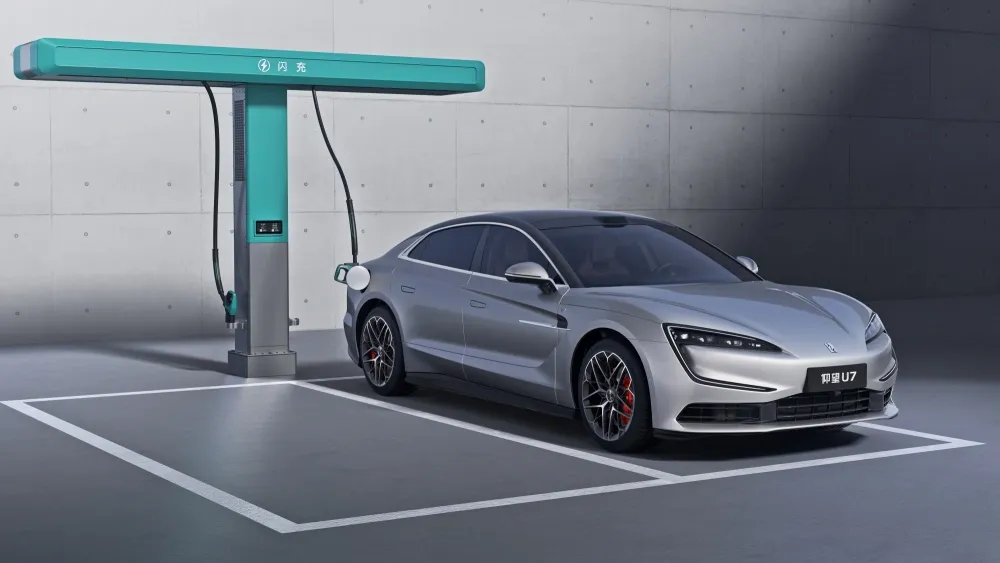
Nine minutes is about how long many drivers spend stretching, grabbing coffee, and checking directions. BYD says that can also be enough time to take an EV from low charge to nearly full.
For buyers who still worry about slow charging, winter range loss, and long lines at highway stops, that claim lands hard. In Shenzhen, BYD showed a Yangwang U8L charging from 10% to 97% in 9 minutes and 7 seconds, and a Seal 06 reaching 97% in 9 minutes and 31 seconds at -35°C. If those results hold in daily use, one of the oldest arguments against EVs gets much weaker.
The bigger story is not one flashy demo. It’s the mix of speed, cold-weather performance, and a huge charger rollout.
What BYD showed in Shenzhen, and why it matters
BYD’s headline numbers were simple enough to stop people mid-scroll. A Yangwang U8L went from 10% to 97% in 9 minutes and 7 seconds. A Seal 06 reached 97% from 20% in 9 minutes and 31 seconds, even at -35°C.
These are the figures BYD highlighted:
| Scenario | Time |
|---|---|
| 10% to 70% | 5 minutes |
| 10% to 97% | 9 minutes |
| -30°C, 20% to 97% | no more than 12 minutes |
The point isn’t only speed. BYD says this is the world’s fastest mass-produced charging speed, not a lab-only exercise or a concept car stunt. That matters because EV drivers don’t live in test chambers. They deal with school runs, holiday traffic, and chargers that feel painfully slow when the clock is ticking.
The charger looks built for daily use
The hardware also sounds built for normal hands, not only spec sheets. BYD says the charger can slide left or right, and that it’s lightweight and flexible. At this power level, cable weight and heat control matter a lot, which is why it helps to know how DC fast charging works.
Cold weather is the part skeptics notice
Winter has always been one of the hardest EV fears to shake. Batteries charge slower when they’re cold, and range often drops at the same time. So the -35°C and -30°C results matter because they target a real pain point, not a perfect-day record.
The rollout plan may matter more than the stopwatch
BYD says it wants 20,000 flash charging stations across China by year end, with sites at nearly a third of all highway service stations. That works out to roughly every 100 kilometers, or about 62 miles.
Coverage like that changes road trips. Even the fastest charger feels slow if five cars are waiting ahead of you. More stations should mean shorter lines, easier planning, and less pressure to top up early because the next stop feels uncertain.
BYD also says overseas stations are planned by the end of 2026. For buyers in Europe and the UK, where interest in BYD keeps growing, a visible charging network could make the brand feel more practical, not only affordable.
Blade Battery 2.0 goes after speed and range at the same time
For years, EV makers treated this as a hard trade-off. You could have ultra-fast charging, or you could have high energy density. BYD says Blade Battery 2.0 narrows that gap. The company says energy density is up by more than 5%, and it pairs that with lighter engineering and tighter battery integration in the chassis.
That packaging matters because saved space and weight usually help efficiency. BYD says the Denza Z9 GT can travel more than 1,036 kilometers, about 644 miles, on a charge. Details in BYD’s Blade Battery 2.0 announcement frame this as a battery-and-vehicle design story, not a charger story alone.
Comments around the demo made the same point. Reactions from the US, Russia, Ireland, and the UK focused on the wider effect, less range anxiety, better battery packaging, and a stronger case for affordable EVs.
Why the rest of the world is paying attention
This isn’t happening in a small corner of the car business. China’s government work report said 2025 NEV production passed 16 million units, while charging infrastructure topped 20 million units. That’s a huge base for testing, scaling, and lowering costs.
China’s Ministry of Industry and Information Technology says the next push is toward all-solid-state batteries and higher-level autonomous driving. So 2025 was about size. The next phase is about deeper battery and vehicle tech, and BYD’s flash charging demo fits that shift.
Final thoughts
BYD’s claim matters because it goes straight at the three complaints that still slow EV adoption: charging time, winter performance, and road trip convenience. A 9-minute stop won’t erase every concern, but it moves the experience much closer to what gas drivers expect.
If BYD can match the demo with real stations at scale, fast charging stops feeling like a compromise. It starts feeling normal.