
🔋 Introduction
The electric vehicle (EV) revolution is accelerating across the globe, and Canada is no exception. With long highways, diverse climates, and vast geography, one of the biggest challenges for Canadian EV drivers has been charging accessibility.
Enter Tesla’s Supercharger Network — a high-speed, reliable, and ever-expanding infrastructure that allows drivers to travel coast-to-coast with confidence. The Tesla Supercharger coverage map in Canada serves as a vital tool, helping drivers plan routes, locate stations, and understand where fast charging is available.
In this article, we’ll provide an in-depth look at:
-
Tesla’s Supercharger network in Canada
-
Regional coverage and expansion trends
-
How to read and use the Supercharger map
-
Benefits for Tesla and non-Tesla drivers
-
Tables showing coverage by province
-
Future updates and planned sites
⚙️ What Is the Tesla Supercharger Network?

The Tesla Supercharger Network is a global system of direct current (DC) fast-charging stations built specifically for Tesla vehicles. Each Supercharger can deliver high-power electricity, allowing Tesla cars to charge up to 322 km (200 miles) of range in about 15 minutes under ideal conditions.
🧠 Key Features:
-
Ultra-fast charging: Up to 250 kW per stall (V3 Superchargers).
-
Smart routing: Tesla’s navigation automatically directs drivers to optimal chargers.
-
Real-time monitoring: The in-car display and Tesla app show availability and wait times.
-
Expanding access: New NACS adapters and open-access sites allow non-Tesla EVs to use select Superchargers.
Tesla’s investment in infrastructure sets the brand apart. The Supercharger coverage map in Canada showcases this achievement — connecting cities, rural areas, and even remote stretches of the Trans-Canada Highway.
🗺️ Overview: Tesla Supercharger Coverage Map in Canada (2025)
The Tesla coverage map displays every active, under-construction, and proposed station across Canada. You can view it on the official Tesla website or through resources like Drive Tesla Canada and Supercharge.info.
As of January 2025, Canada has over 210 operational Supercharger sites and more than 2,300 charging stalls, with dozens more planned throughout the year.
📊 Table: Tesla Supercharger Coverage by Province (2025)
| Province / Territory | Estimated Locations | % of Total | Key Cities Covered |
|---|---|---|---|
| Ontario | 74 | 35% | Toronto, Ottawa, London, Windsor |
| British Columbia | 57 | 27% | Vancouver, Kelowna, Nanaimo, Kamloops |
| Quebec | 31 | 15% | Montreal, Quebec City, Gatineau |
| Alberta | 18 | 9% | Calgary, Edmonton, Canmore |
| Saskatchewan | 13 | 6% | Regina, Saskatoon |
| Manitoba | 7 | 3% | Winnipeg, Brandon |
| New Brunswick | 6 | 3% | Moncton, Fredericton |
| Nova Scotia | 2 | 1% | Halifax, Truro |
| Prince Edward Island | 1 | 0.5% | Charlottetown |
| Yukon / NWT / Nunavut / Newfoundland | 0 | — | No coverage yet |
Source: DriveTeslaCanada.ca, ScrapeHero EV Data (2025)
🧭 How to Read and Use the Supercharger Map
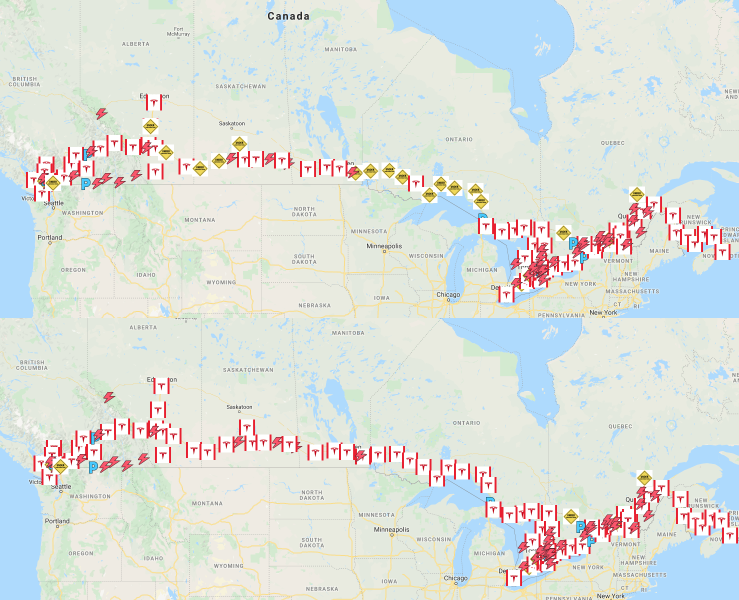
The Tesla Supercharger Map is interactive and simple to use. It displays:
-
Red pins → Open and operational Superchargers
-
Grey pins → Under construction or planned sites
-
Power ratings → Indicate charger generation (V2 or V3)
-
Amenities icons → Nearby restrooms, cafes, Wi-Fi, etc.
🧩 Step-by-Step Use:
-
Go to Tesla’s Find-Us Page.
-
Zoom in on your area or route.
-
Click on any pin for details (address, stall count, type).
-
In your Tesla app or car, navigate to that Supercharger to see availability in real time.
This map isn’t just for trip planning — it helps identify charging deserts and observe Tesla’s progress in connecting remote regions.
🌍 Regional Analysis of Tesla Supercharger Coverage in Canada
🏙️ 1. Ontario – The Supercharger Capital
Ontario leads with more than 70 stations, mainly concentrated in the Greater Toronto Area (GTA), Ottawa, and along Highway 401.
Tesla has strategically positioned chargers every 100–150 km along major routes.
Highlights:
-
Dense coverage ensures zero range anxiety in southern Ontario.
-
Expansion toward northern Ontario underway (Sudbury, Thunder Bay).
-
Convenient stops along Highway 400 and Trans-Canada routes.
🌲 2. British Columbia – Scenic and Supercharged
British Columbia has over 55 Supercharger sites, serving both urban centers and tourism corridors like the Sea-to-Sky Highway.
Notable Locations:
-
Vancouver, Richmond, Hope, Kamloops, Kelowna, and Prince George.
-
Vancouver Island now has strong coverage, including Nanaimo, Courtenay, and Victoria.
Tesla continues to add chargers in smaller coastal and interior towns, enabling full electric travel from Vancouver to Calgary.
🏔️ 3. Alberta – Growing Rapidly
Alberta hosts around 18 Supercharger locations, with dense coverage near Calgary and Edmonton, and new additions in Canmore and Red Deer.
Tesla has been improving infrastructure to make Banff National Park fully accessible for EV tourists.
🌾 4. Saskatchewan and Manitoba – Bridging the Prairies
The wide open prairies of Saskatchewan and Manitoba can pose challenges for EV range. Tesla has made these provinces drivable by strategically spacing stations along Trans-Canada Highway 1.
-
Saskatchewan: ~13 stations between Regina, Swift Current, and Saskatoon.
-
Manitoba: 7 stations connecting Winnipeg to the Ontario border.
Though coverage is thinner, expansion projects for 2025 aim to reduce long gaps between charging stops.
🏡 5. Quebec – Francophone EV Frontier
Quebec has 30+ Supercharger sites and one of the highest EV adoption rates in Canada.
Tesla’s network supports Montreal to Quebec City routes and connects with the U.S. border.
Upcoming plans:
New sites in Trois-Rivières, Lévis, and Chicoutimi, plus additional stations on Autoroute 20 and 40.
🌅 6. Atlantic Canada – Emerging Market
Atlantic Canada’s EV scene is smaller, but Tesla’s presence is steadily growing.
-
New Brunswick: 6 locations
-
Nova Scotia: 2 sites (Halifax and Truro)
-
PEI: 1 station in Charlottetown
Plans are underway for expansion to Newfoundland and Labrador by 2026.
🧊 7. Northern Territories – The Final Frontier
As of 2025, Yukon, NWT, and Nunavut have no active Supercharger sites.
However, pilot programs for Level-3 fast chargers are under review in Whitehorse and Yellowknife.
Tesla’s long-term vision includes Arctic-grade charging infrastructure, addressing extreme cold weather challenges.
⚡ Tesla Supercharger Technology Explained
To appreciate the coverage map, it’s important to understand how these chargers work.
| Charger Type | Power Output | Charging Speed | Typical Location |
|---|---|---|---|
| V2 Supercharger | Up to 150 kW | 270 km in 30 min | Older sites |
| V3 Supercharger | Up to 250 kW | 322 km in 15 min | Most new sites |
| Urban Supercharger | Up to 72 kW | 160 km in 30 min | City centers & parking garages |
V3 Superchargers dominate new Canadian installations, offering faster charging and better cold-weather performance.
🛣️ Long-Distance Travel on Tesla Supercharger Routes

The Trans-Canada Highway is now mostly covered by Superchargers, allowing a coast-to-coast EV journey.
Example Route: Vancouver → Toronto
-
Total Distance: 4,400 km
-
Charging Stops: ~18
-
Total Charging Time: ~5.5 hours (spread across trip)
-
Average cost: ~$200 CAD (depending on rates)
Tesla’s in-car Trip Planner automatically calculates optimal stops, factoring terrain, temperature, and battery health.
📈 Growth Trends: Tesla’s Canadian Expansion 2025–2030
| Year | Supercharger Locations | % Increase | Key Expansion Provinces |
|---|---|---|---|
| 2020 | 138 | — | Ontario, BC |
| 2022 | 178 | +29% | Quebec, Alberta |
| 2024 | 209 | +17% | Atlantic Canada |
| 2025 (Projected) | 260+ | +24% | Manitoba, N. Ontario, Remote BC |
Tesla’s 2025 roadmap includes 50+ new sites with a focus on remote areas, ski towns, and interprovincial highways.
This expansion aligns with Canada’s Zero-Emission Vehicle (ZEV) target of 100% new EV sales by 2035.
🌿 Benefits of the Supercharger Network for Canada
The Supercharger network’s impact extends far beyond convenience:
-
Accelerates EV adoption — Reduces “range anxiety.”
-
Supports sustainable travel — Encourages emission-free road trips.
-
Boosts local economies — Drivers spend time at nearby cafes, malls, and attractions.
-
Promotes energy innovation — Tesla integrates renewable power at some stations.
-
Encourages infrastructure parity — Pushes other networks (FLO, Petro-Canada) to expand.
💡 Tesla’s Future Charging Innovations
Tesla is leading innovation in fast-charging technology:
-
V4 Superchargers — Up to 350 kW, featuring longer cables for non-Tesla EVs.
-
Solar-powered sites — Tesla integrates solar canopies to offset grid dependence.
-
Energy storage (Megapacks) — Allow off-grid or rural station operation.
-
Dynamic pricing models — Lower rates during off-peak hours.
These improvements will make the Canadian Supercharger map even more vital for EV planning and sustainability.
🧰 Practical Tips for Using Tesla Superchargers in Canada
-
Pre-condition your battery before arrival for faster charging.
-
Plan winter trips carefully — Cold weather slows charging rates.
-
Use the Tesla app to check real-time availability and pricing.
-
Avoid “idle fees” — Move your car when charging completes.
-
Combine breaks with charging — Choose stations near food and rest stops.
-
Stay updated — Tesla adds or relocates stations regularly.
🪙 Cost of Charging in Canada
Charging at Tesla Superchargers in Canada typically costs between $0.24 and $0.45 per kWh, depending on location and time of day.
Example Table: Charging Cost by Province
| Province | Avg. Rate (CAD/kWh) | 0–80% Charge (Model Y) | Est. Range Added |
|---|---|---|---|
| Ontario | $0.28 | $14.00 | 360 km |
| British Columbia | $0.33 | $16.50 | 340 km |
| Alberta | $0.26 | $13.00 | 370 km |
| Quebec | $0.29 | $14.50 | 360 km |
Tesla bills directly through the app — no need for cards or cash.
🧱 Limitations of the Current Network
Even with impressive coverage, a few gaps remain:
-
Sparse northern infrastructure (e.g., Yukon, Labrador).
-
Occasional wait times at busy sites during holidays.
-
Limited support for non-Tesla vehicles (though improving).
-
Weather impacts — Extreme cold reduces range and charging efficiency.
Tesla is addressing these by:
-
Adding redundant chargers at high-traffic stations.
-
Upgrading older V2 sites to V3.
-
Partnering with governments for funding northern routes.
📅 Upcoming Tesla Supercharger Sites in Canada (2025 Announced)
| Province | City / Area | Status | Expected Opening |
|---|---|---|---|
| British Columbia | Campbell River | Under Construction | Q1 2025 |
| Alberta | Canmore (Expansion) | Planned | Q2 2025 |
| Ontario | Milton, Barrie | Planned | Q2 2025 |
| Quebec | Lévis | Proposed | Q3 2025 |
| Manitoba | Kenora | Proposed | Q4 2025 |
| Nova Scotia | Antigonish | Planned | Q4 2025 |
Tesla’s 2025 expansion map shows over 17 confirmed new locations, focusing on rural and tourist-heavy corridors.
🧭 How to Check Real-Time Supercharger Availability
Tesla’s in-car navigation or mobile app displays:
-
Station capacity and stall count
-
Charging rate (kW)
-
Current occupancy (number of cars)
-
Nearby amenities
This ensures efficient travel planning — no more guessing or waiting unnecessarily.
🔮 The Future of EV Charging in Canada
As the federal and provincial governments invest billions in EV infrastructure, Tesla’s map will continue to evolve.
Key national initiatives:
-
Natural Resources Canada (NRCan) funding 50,000 new charging ports by 2030.
-
Tesla–NRCan partnerships to expand NACS stations accessible to all EVs.
-
Integration with renewable grids and battery storage.
By 2030, expect 400+ Supercharger sites across Canada — making long-distance, zero-emission travel truly seamless.
🌟 Conclusion: Powering Canada’s Electric Future
The Tesla Supercharger coverage map in Canada is more than a navigation tool — it’s a symbol of progress in sustainable mobility.
From dense city networks in Ontario and BC to new routes in Atlantic and Prairie provinces, Tesla continues to lead the charge toward a greener future.
Whether you’re planning a family road trip, daily commute, or cross-country adventure, this map ensures you’ll always find power where you need it most.