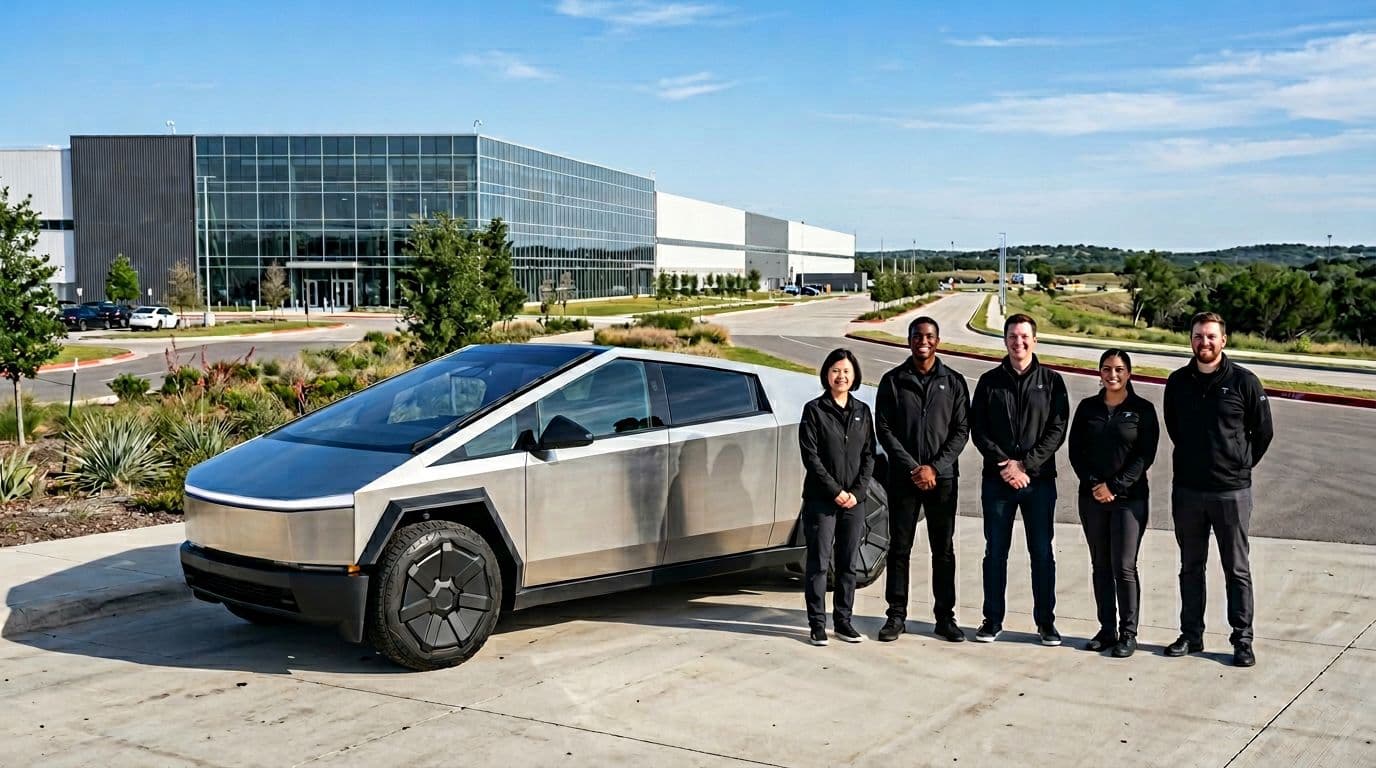
Tesla had a busy week, and the headline is production Cybercab. The company says the first production unit is now out of Giga Texas, which shifts the robotaxi story from concept talk to manufacturing reality. At the same time, signs point to the Tesla Semi expanding toward Europe, The Boring Company picked up traction with a Texas township, and Cybertruck pricing moved in a way that explains how Tesla tests demand in real time.
Tesla hits a milestone with the first production Cybercab at Giga Texas
Cybercab moves from prototype to scaled manufacturing
Tesla posted a photo of what it described as the first production Cybercab at Giga Texas, shown alongside the local team. That type of post matters because it signals an internal transition: the vehicle is no longer framed as a prototype or a one-off engineering mule. Instead, it’s entering the controlled world of build sequences, stations, and repeatable processes.
It’s now moving through manufacturing processes that are intended to scale dramatically.
Until now, Tesla’s autonomy push has mostly used an install base strategy. In other words, Tesla shipped cars with conventional controls, then improved behavior using software updates on vehicles already driving on public roads. The Cybercab changes that approach because it’s a vehicle designed around autonomy from day one, which forces different decisions about packaging, safety assumptions, service operations, and fleet uptime.
A production milestone also makes “timeline talk” harder to ignore. Manufacturing means tooling, supplier schedules, and staffing plans. Even before public deliveries, a production line indicates Tesla is building the operational muscle it needs for volume, not just demos. For more context on the reporting around the first unit, see Electrek’s report on the first steering-wheel-less Cybercab.
No steering wheel, no pedals, no fallback
The Cybercab is described as the first Tesla designed without a steering wheel or pedals. That’s more than a design detail. It means the vehicle architecture assumes autonomy as the only operating mode, not a driver-assist layer on top of a human-driven car.
During Tesla’s 2025 earnings call, Elon Musk summarized the design philosophy in plain terms:
“There’s no fallback mechanism here. It’s like this car either drives itself or it does not drive.”
A no-controls vehicle pushes several technical and operational implications:
- No manual override path: The system can’t rely on “driver takeover” as a safety valve. That increases the pressure on perception, planning, and fault handling.
- Autonomy-first packaging: Interior space, seating layout, and service access can prioritize sensors, compute, and passenger use, not driver ergonomics.
- Fleet assumptions: If the goal includes robotaxi use, dispatch, routing, and charging become core requirements, not optional extras.
Musk also said he expects Cybercab to become Tesla’s highest-volume vehicle, potentially outselling Model 3 and Model Y combined. That outcome depends on a simple constraint: the Cybercab has to be attractive to regular buyers, not just fleet operators.
Cybercab pricing under $30,000 and the ecosystem around it
On X, Musk answered “yes” when asked whether Tesla would sell a Cybercab to customers for $30,000 or less before 2027. If Tesla reaches that target on the stated timeline, it places a fully autonomous vehicle into a price band that competes with entry-level gas cars as well as many mainstream EVs. That would be one of Tesla’s most aggressive ramps if it happens as described.
Tesla also appears to be thinking beyond the vehicle. The company recently sought regulatory approval connected to ultra-wideband wireless charging for the Cybercab. For an autonomous vehicle, wireless charging is not just a convenience. It reduces dependency on human labor and can increase fleet utilization, since a car can top up energy without a plug-in step.
Another signal is a customer experience move. Tesla hired the developer behind the community tool Robo Taxi Tracker. In a LinkedIn post, Ethan McKenna said, “This summer, I’ll be joining the vehicle software team as an intern where I’ll have the chance to help build the robo taxi experience.” That points toward a product layer that many robotaxi plans overlook: visibility, status, trust signals, and clear fleet behavior for riders.
Under the hood, autonomy also depends on compute. For a deeper look at Tesla’s next-gen processing direction, see Tesla AI5 chip specs and FSD power.
Outskill’s 2-day AI mastermind (free seat offer)
The sponsor segment focused on a simple claim: AI skills now correlate with income and outcomes, and “AI isn’t optional anymore.” It cited examples like a million-dollar AI film win on stage, a teen running an AI automated agency at six figures a month, and a Forbes-referenced claim that employees who use AI earn about 40% more than those who don’t.
Outskill is positioned as an AI education platform that aims to turn AI into practical workflows. They’re hosting a live 2-day AI mastermind this weekend, and the offer described is free for the next 48 hours.
Here are the key event details mentioned:
| Feature | Details |
|---|---|
| Schedule | Saturday and Sunday, 10:00 AM to 7:00 PM Eastern |
| Cost window | Free for the next 48 hours (as stated) |
| Reported reach | Helped 10M+ AI-first professionals |
| Rating | 4.9 out of 5 on Trustpilot (as stated) |
The curriculum claims to cover three core outcomes:
- Building AI agents
- Automating workflows
- Connecting tools like spreadsheets, CRM, Notion, and email into working systems
The offer also mentions bonuses for attending both days, plus access to a “2026 AI survival hackbook.” Registration is available via Outskill’s free 2-day AI mastermind seat offer.
Tesla Semi signals a push toward Europe
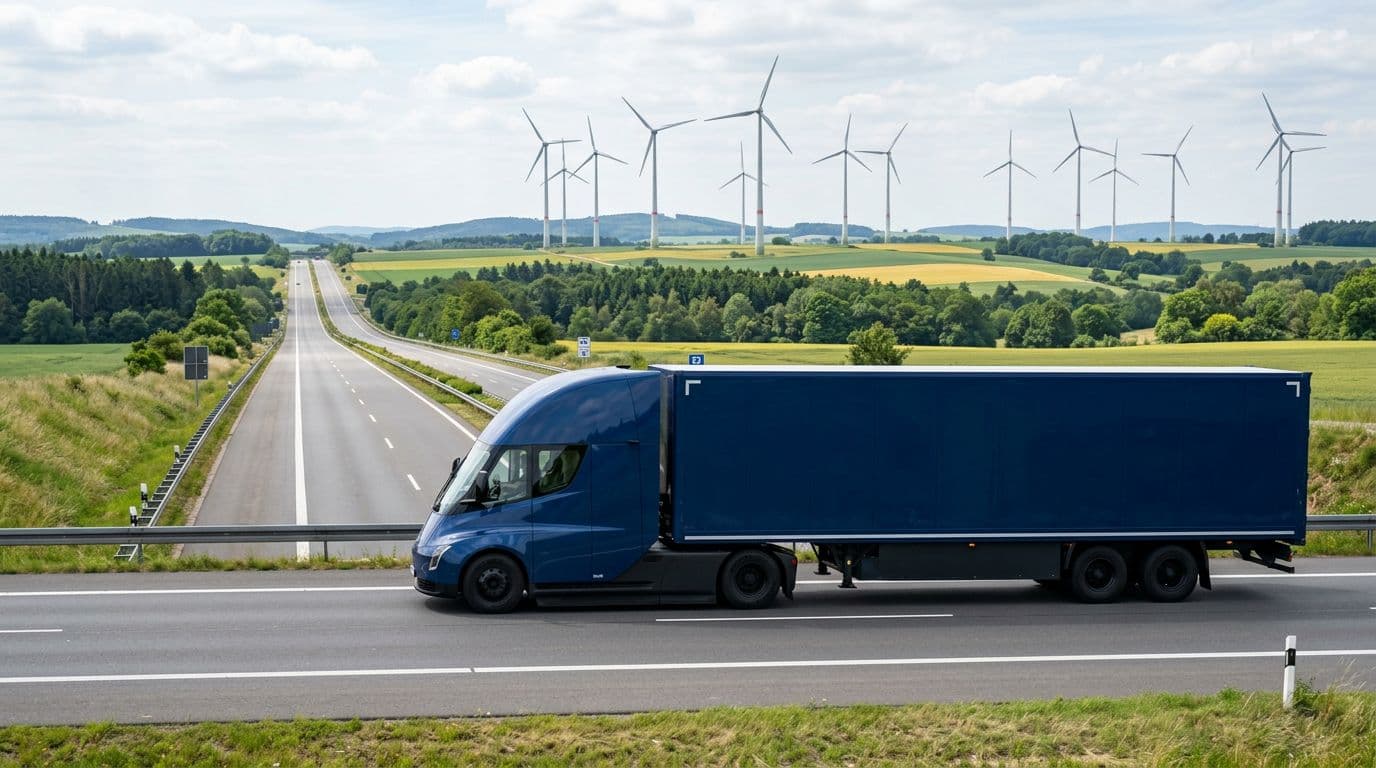 Visualization of an electric semi truck on a European highway.
A megacharger job listing hints at real infrastructure plans
A job listing tied to Tesla’s commercial charging team referenced megacharger deployment in Europe. That detail matters because heavy-duty charging isn’t something you typically build “just in case.” Truck charging corridors require site selection, grid work, hardware deployment, and uptime planning. Those costs usually track a real operational intent.
In practice, megachargers function as the enabling layer for any electric freight plan. Without predictable charging lanes, fleet operators can’t schedule routes, duty cycles, or delivery windows with confidence. A staffing signal suggests Tesla is laying groundwork instead of waiting for a future phase.
For more context on the job listing angle, see Teslarati’s report on the Commercial Charging role tied to Europe or Not a Tesla App’s coverage of megachargers coming to Europe.
Semi specs that make Europe a logical next step
The transcript highlighted three key Semi numbers, and they map cleanly to how many European freight corridors operate. Here’s the quick reference:
| Spec | Value (as stated) |
|---|---|
| Range | ~500 miles |
| Energy use | ~1.7 kWh per mile |
| Gross combination weight | Up to 82,000 lb |
In the US, those specs target long-haul routes that can run hundreds of miles between stops. In Europe, routes often involve shorter distances and structured cross-border corridors. That makes a 500-mile class truck workable for many operators, assuming charging sites exist where trucks actually idle and stage.
Cost pressure also shifts the equation. Diesel prices in Europe are often higher than in the US, which improves the operating-cost argument for electrification. In parallel, European emissions rules and incentives tend to push fleets toward lower-carbon options sooner, especially for large operators that must report and reduce supply chain emissions.
FSD safety incentives and production ramp signals
Fleet decisions aren’t only about fuel. Safety, liability, and downtime can dominate total cost. Tesla’s updated FSD safety report was referenced as showing vehicles operating with the system engaged being roughly seven times less likely to be involved in a collision. If a fleet buyer believes that ratio holds in its routes, it becomes a strong incentive because collisions create cascading costs: repairs, insurance, missed loads, and driver availability.
On the manufacturing side, the Semi program has stayed quieter than consumer vehicles, yet sightings near the Semi factory by Giga Nevada suggest the production footprint is advancing. Musk also stated on X that Tesla Semi starts high-volume production this year. If Europe-bound megacharger work is real, it supports the idea that Tesla is preparing not just trucks, but the system those trucks depend on.
The Woodlands Township considers a Boring Company tunnel for event traffic
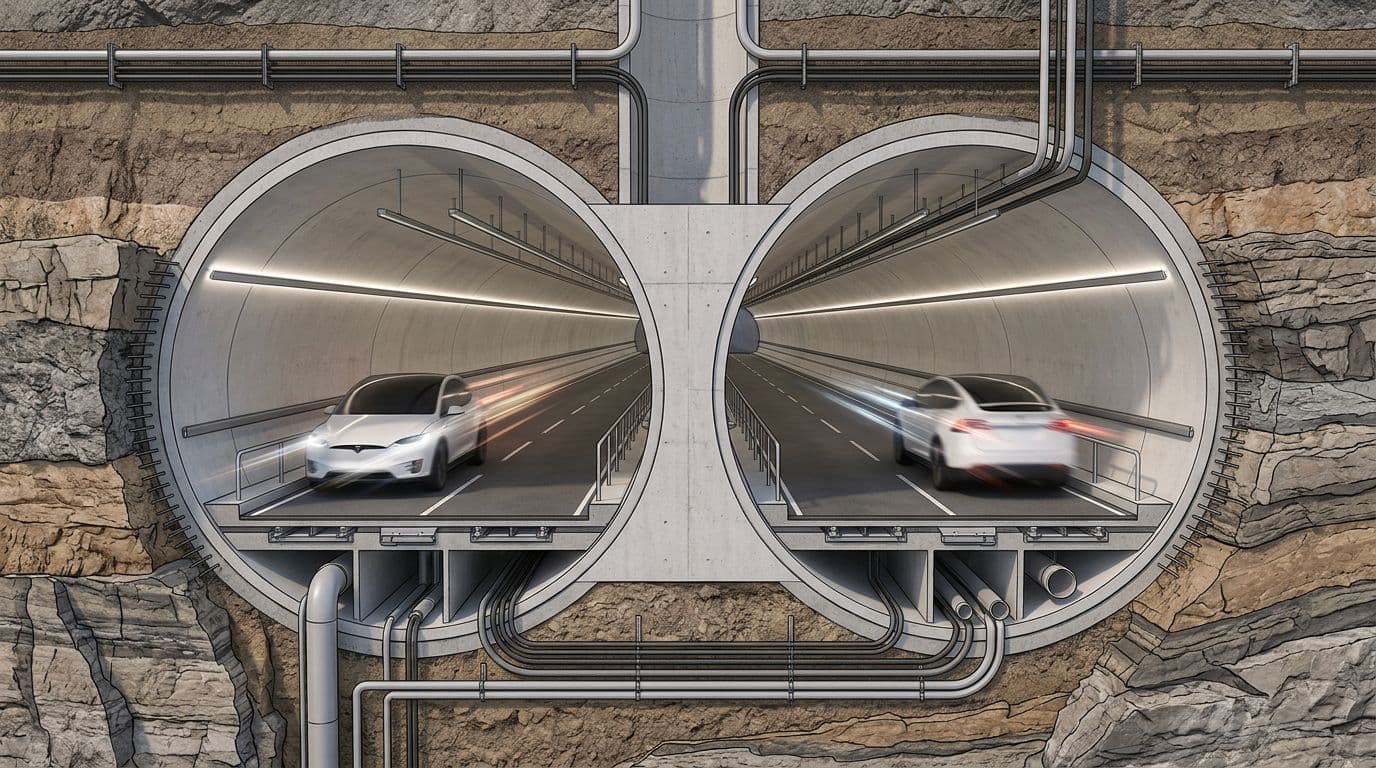 Cross-section view of two parallel tunnels with vehicle shuttles.
Why event congestion is a different kind of traffic problem
The Woodlands Township in Texas moved forward in response to The Boring Company’s “Tunnel Vision Challenge,” approving steps to explore a tunnel concept aimed at event-driven congestion. Unlike daily commuter traffic, event traffic is bursty and time-bound. Everyone arrives in a tight window, then leaves in another tight window. Roads that feel fine at 4:00 PM can lock up completely by 7:15 PM.
The pressure point described is the town center area, which sees heavy gridlock during concerts and large gatherings. The Cynthia Woods Mitchell Pavilion alone hosts over 60 performances annually and can hold crowds up to 16,500 people per show. That creates a predictable but intense flow problem: high pedestrian volume, limited curb space, and a surge in drop-offs and pickups.
Chris Nunes, the township’s chief operating officer, described the constraint clearly: “We know we have traffic impacts and pedestrian movement challenges, especially in the town center area.”
For background reporting, see Teslarati’s coverage of The Woodlands Loop proposal and The Woodlands Township site.
“The Current” proposal and how a Loop-style shuttle would work
The exploratory proposal is called “The Current.” It features two parallel 12-foot diameter tunnels beneath the town center corridor near the waterway. The system concept follows the Loop pattern: vehicles move passengers point-to-point inside a controlled tunnel environment.
A few implementation details shape how this could operate:
- Two parallel tunnels: Separation supports directional flow and can simplify operations during surges.
- Tesla vehicle shuttles: Using production vehicles can speed deployment compared with bespoke transit vehicles.
- Autonomy optionality: The design leaves open future integration of autonomous platforms like Cybercab or a Robo Van.
Because the problem is concentrated around venues and specific amenities, the tunnel’s value isn’t tied to citywide commuting. It’s tied to event ops. That can make a pilot easier to measure, since success metrics look like queue time, throughput, and pedestrian safety improvements during known peaks.
What this says about the Boring Company’s direction
The township’s move doesn’t finalize cost, scope, or timelines, yet it reinforces a broader shift. The Boring Company is being evaluated as a practical tool for targeted choke points, not only as a demo.
Nunes summarized the board’s view by saying an underground tunnel could provide “a safe and efficient means to transport people to and from various high use community amenities in our town center.” If similar proposals keep showing up, Loop systems may start looking less like a concept pitch and more like a menu item for towns with predictable surge traffic.
For related context on recent tunnel coverage, the channel referenced a prior video, Elon Musk Reveals Major New Boring Company Update!.
Cybertruck hits an inflation-aligned price, then gets a time limit
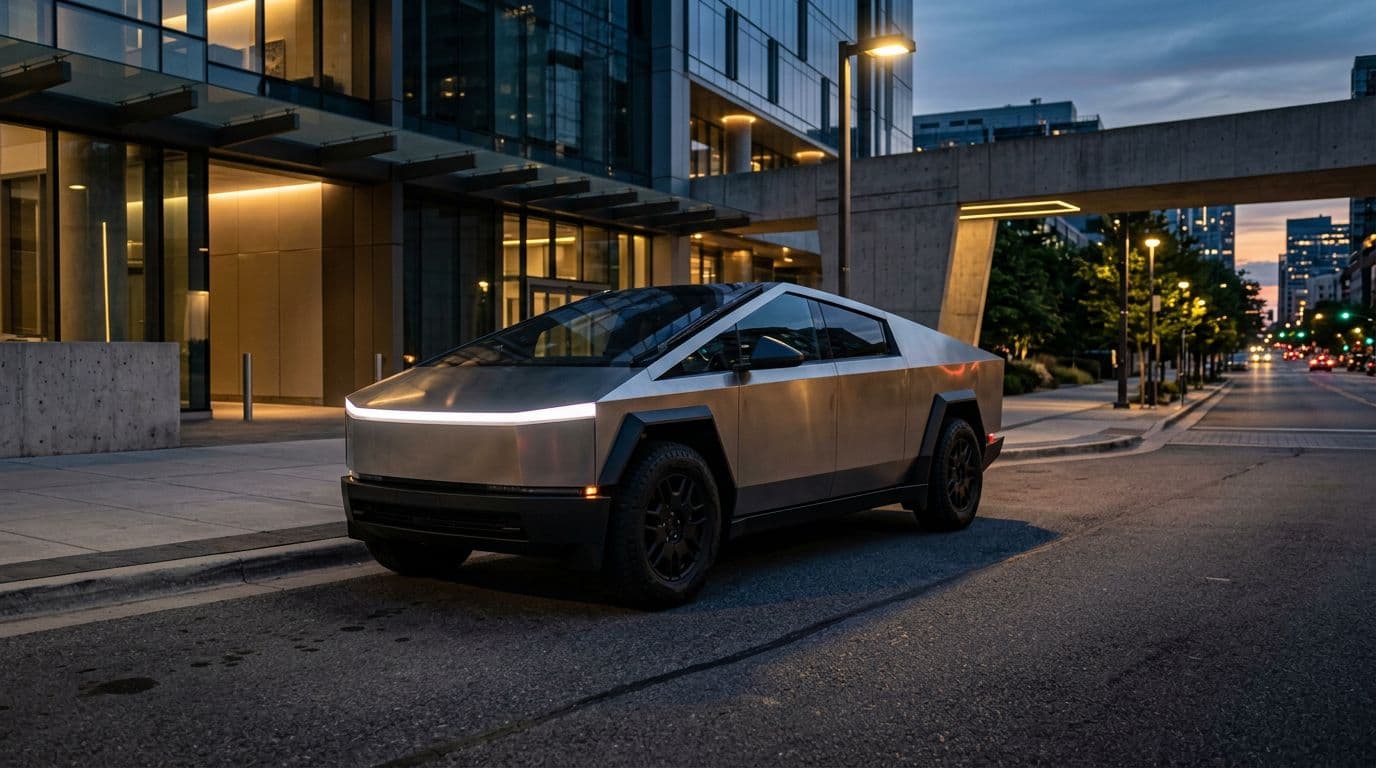 A stainless steel pickup parked in a city setting at dusk.
A dual-motor AWD Cybertruck under $60,000 changes the entry point
Tesla introduced a new Cybertruck dual-motor all-wheel drive configuration priced below $60,000. The reaction was fast because it hit a key psychological threshold while keeping the dual-motor setup. It also addresses complaints about earlier lower-end configurations that lacked basic utility features.
The transcript contrasted this configuration with an earlier rear-wheel drive variant that didn’t include items like a power tonneau cover and onboard outlets. With trucks, those features are not cosmetic. They shape real use cases: jobsite power, weather protection for tools, and daily convenience.
The pricing reaction also ties back to history. When Musk unveiled Cybertruck in November 2019, the dual-motor AWD variant was listed at $49,990. Adjusted for cumulative US inflation through 2026 (as described), that lands around $63,000. In other words, the sub-$60,000 announcement felt like the first time the Cybertruck was roughly aligned with its original promise on an inflation-adjusted basis.
For a broader view of how Cybertruck stacks up against other long-range electric pickups in the US market, see electric pickups with long range in the USA.
“Only for the next 10 days” and demand-based pricing
After the initial excitement, Musk posted on X that the variant’s cost would apply only for the next 10 days. He later added that the dual-motor AWD price depends on how much demand Tesla sees at that price level.
That triggered two interpretations. One camp saw it as a standard Tesla move: adjust trims and pricing to balance production, manage parts, and test demand elasticity. The other camp saw it as a momentum hit, because buyers who finally saw the “right” price also saw a countdown attached to it.
For external coverage of the pricing shift and its timing, see Electrek’s report on the Cybertruck AWD price increase after a short window and Not a Tesla App’s update on the dual-motor AWD price hike.
A longer-term pivot: Cybertruck as an autonomous work platform
The most strategic line in the transcript came from Tesla’s earnings call: Musk said Tesla will transition the Cybertruck line to “just a fully autonomous line.” In that same discussion, he described an autonomous Cybertruck as effective for localized cargo delivery within cities.
That framing explains why retail trims might look temporary. If Tesla expects Cybertruck to play a commercial autonomy role, then today’s consumer packaging could be an interim phase while Tesla scales manufacturing and tests what the market will actually pay.
Capacity matters here. Tesla’s recent update letter reportedly states Giga Texas’s Cybertruck line has capacity above 125,000 vehicles per year. That’s a large output for a vehicle bigger than Cybercab and Model Y. If Tesla later repurposes even part of that volume toward autonomous delivery fleets, pricing experiments now start to look like data collection, not random discounting.
Cybertruck is also an energy-heavy platform compared with smaller Teslas. For readers tracking efficiency, see Cybertruck energy consumption Wh/mi in Tesla’s model chart.
Follow updates and supporting links
Ongoing coverage and community links referenced include The Tesla Space newsletter, the Tesla Space Discord community, and the Tesla Space merch store. The channel also shared a Tesla product referral link for purchase benefits.
Conclusion
This week’s theme is execution. The Cybercab moved into production framing, the Semi showed signs of Europe-bound infrastructure planning, a Texas township treated tunneling as a serious congestion tool, and Cybertruck pricing behaved like a live demand test. Tesla’s strategy looks less like isolated product launches and more like a stack: vehicles, charging, operations, and the user experience that ties it together. The next big question is whether Tesla can match autonomy claims with deployment speed, because production milestones only matter if real-world performance follows.