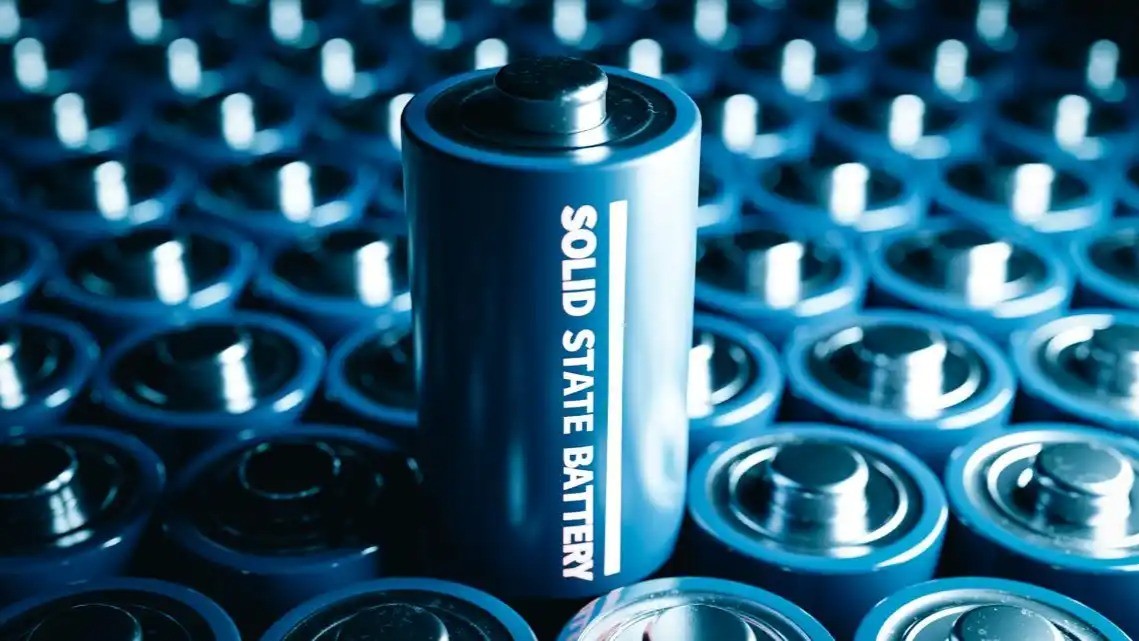
Everyone wants the same thing from batteries: more range, faster charging, safer cars, and phones that don’t die by dinner. That’s why solid-state battery headlines keep popping up, especially in EV news.
A solid-state battery manufacturer makes battery cells that replace the flammable liquid electrolyte in today’s lithium-ion batteries with a solid material, then tries to produce those cells reliably at factory scale.
In February 2026, the honest picture is simple: the tech looks promising, but most real products are still in pilot builds or early ramp-up. This guide explains what “solid-state” means, how manufacturers build these cells, what’s hard, who’s pushing ahead, and how to separate real progress from a nice slide deck.
What a solid-state battery is, and how it is different from today’s lithium-ion packs
A battery cell has four main parts: anode, cathode, electrolyte, and a separator. The anode and cathode store energy through chemical reactions. The electrolyte moves ions between them. The separator keeps the two electrodes from touching, which prevents a short circuit.
In today’s lithium-ion packs, the electrolyte is usually a liquid soaked into a porous separator, kind of like a wet sponge between two layers. That liquid helps ions move quickly, which is great for power. However, it also brings tradeoffs: it can be flammable, it can react with moisture, and it can struggle under abuse or high heat.
Solid-state designs swap that liquid for a solid electrolyte. In some designs, the solid electrolyte also replaces the separator. In theory, this change can improve safety, allow a tighter internal design, and enable higher energy density. In other words, it can pack more energy into the same space.
However, that same change introduces new problems. Solids don’t “flow” into tiny gaps the way liquids do. If layers lose contact, resistance rises, heat increases, and performance drops. Solid-state isn’t magic, it’s a different set of engineering compromises.
Liquid vs solid electrolyte, explained in plain English
Picture a kitchen sponge on a counter. The sponge (liquid electrolyte in a porous separator) can squish and fill small gaps. Now picture a hard tile (solid electrolyte). The tile stays in shape, but if the surfaces aren’t perfectly flat, tiny air pockets form.
Those microscopic pockets matter because ions don’t like crossing voids. As a result, solid-state makers spend a lot of effort on interface contact (how well layers touch) and mechanical stability (keeping that contact over time).
Most solid electrolytes fall into three broad families:
Here’s a quick way to compare them at a high level.
| Solid electrolyte family | What it tends to do well | Common tradeoffs manufacturers manage |
|---|---|---|
| Sulfide | High ion conductivity, can support strong power | Often moisture-sensitive, can form unwanted byproducts if exposed |
| Oxide | More stable against moisture and heat in many cases | Hard and brittle, can need higher processing temperatures |
| Polymer | Flexible, easier to handle in some processes | Often needs warmer temps for good conductivity, may limit power |
No single family “wins” across every requirement. A solid-state battery manufacturer usually picks a chemistry that matches the product target (EV, consumer electronics, industrial) and the factory reality (equipment, yield, cost).
Solid-state is less about one miracle material and more about how well a factory can repeat the same tiny interfaces, millions of times.
The benefits people care about most: safety, range, charging, and life
When people hear “solid-state,” they usually think about four outcomes. The important part is keeping expectations realistic because results depend on design, chemistry, and cell format.
- Safety: Many solid-state approaches reduce the amount of flammable liquid in the cell. That can lower fire risk, especially under puncture or overheating. It doesn’t mean “fireproof,” but it can improve the safety margin.
- Range (energy density): Solid-state designs may raise energy density by enabling thinner separators and, in some cases, lithium-metal anodes. Realistic gains vary widely, and some early solid-state cells may only match good lithium-ion at first.
- Faster charging: “Fast charging” is not one number. It’s charging power plus heat control, plus how many cycles the cell survives at that rate. A cell that charges quickly for 50 cycles is not an EV solution.
- Longer life: Solid electrolytes can reduce some side reactions, but they can also introduce cracking and interface wear. Cycle life often improves only after careful engineering.
For EV drivers, range improvements matter most when they show up on the road, not just in lab graphs. If you want a practical baseline for what “good range” looks like today, compare current models first, then ask what solid-state would need to beat. This helps anchor expectations against reality, not hype: EV range comparison by brand in Canada 2025.
How a solid-state battery manufacturer actually builds cells at scale
From the outside, it’s easy to imagine solid-state as a clean break from lithium-ion manufacturing. In practice, it’s more like renovating a house while still living in it. Many steps look familiar, but the “new plumbing” causes the delays.
Most manufacturers still need electrode coatings, precision drying, stacking or winding, packaging, and testing. What changes is how they add the solid electrolyte, how they build stable interfaces, and how they manage pressure inside the cell and module.
Solid-state programs often start with pouch cells. Pouches give engineers more freedom to apply pressure across the stack and adjust layer thicknesses. Cylindrical and prismatic formats can come later, once the interfaces and yields behave.
Key process steps, from materials to finished cell
While each company has its own recipe, the manufacturing flow usually looks like this:
First comes materials preparation. The cathode active material gets mixed with conductive additives and binders. Many designs still coat cathode films onto current collectors, then dry them. Some solid-state designs use different binders or solvent systems, so the coating line may need changes.
Next is the solid electrolyte layer. Depending on chemistry, manufacturers might cast sheets, press powders into dense layers, or deposit thin films. Some oxides require higher-temperature densification steps. Sulfides often require tight moisture control because water exposure can damage performance.
After that, the line moves into stacking and lamination. Layers of cathode, electrolyte, and anode side materials get aligned and pressed. Alignment matters more than most people expect. A tiny wrinkle can become a hot spot later.
Then comes sealing and packaging. Pouch sealing must be clean and repeatable. Any trapped moisture or contamination can create side reactions. Manufacturers may also add mechanical frames or compression hardware at the cell or module level.
Finally, cells go through formation cycling and end-of-line testing. Formation is like “breaking in” the cell under controlled conditions. It reveals early defects and helps stabilize interfaces. Testing screens for shorts, capacity loss, high resistance, and abnormal heat.
Even if you never plan to build a battery, understanding manufacturing steps helps you judge announcements. A lab cell that looks great is only step one. A factory that can make it 24/7 is the real challenge.
If you’re trying to connect battery claims to real driving outcomes, efficiency matters too. A higher energy density cell helps, but vehicle efficiency can add or erase the benefit. This chart is a useful reference point: average kWh per 100 km electric car chart.
The hard part is the interface: keeping layers touching over thousands of cycles
Interfaces are where solid-state projects earn their scars.
As a battery charges and discharges, materials expand and shrink. In liquid cells, the electrolyte can wet new surfaces and keep ion pathways open. In solid-state cells, that motion can create cracks, voids, or loss of contact. When contact degrades, resistance rises, and the cell heats more under load.
That’s why you’ll hear about stack pressure (also called stack force). Many solid-state designs apply controlled pressure to keep layers touching. Too little pressure can cause contact loss. Too much can damage materials, deform the package, or complicate module design.
Lithium-metal anodes add another layer of difficulty. Lithium metal can raise energy density, but it also raises the risk of dendrites, tiny needle-like growths that can pierce through layers and short the cell. Solid electrolytes can help block dendrites, but only if the material and interface stay uniform.
Manufacturers attack these problems with practical tools:
Coatings and buffer layers can smooth rough surfaces. Better particle engineering can improve contact. Some designs add compliant layers that act like a gasket between brittle parts. Others build mechanical frames that keep pressure steady as the cell ages.
In 2026, this is where the race really sits. Materials matter, but repeatable interfaces matter more.
How to judge a solid-state battery manufacturer without falling for hype
Solid-state news can feel like a magic show. One press release says “breakthrough,” another says “pilot line,” and it’s hard to know what changed.
A good approach is to ask: are they showing an EV-ready cell, tested under clear conditions, made on equipment that looks like a real factory? Or are they showing a small sample with missing details?
This section is useful for consumers, engineers switching fields, and curious investors, without turning into financial advice. The goal is simple: focus on proof points that are hard to fake.
Data that matters: energy density, cycle life, fast-charge, temperature, and safety tests
You don’t need a PhD to read battery claims, but you do need the test context.
Energy density tells you how much energy fits in a given mass or volume. For EVs, both gravimetric (Wh/kg) and volumetric (Wh/L) matter because space and weight both limit range.
Cycle life shows how long the cell lasts. Look for capacity retention after hundreds of cycles, and note the depth of discharge. A cell cycled gently can look better than one cycled like an EV.
Fast-charge performance should include charge rate, temperature control, and how cycle life changes when charging hard. “Charges to 80 percent in 10 minutes” means little if it only lasts 200 cycles.
The temperature window matters because EVs face winter mornings and hot summers. Solid-state cells can behave very differently at low temperatures, so look for performance across a range, not just room temperature.
Safety testing should describe abuse conditions. Nail penetration, crush, overcharge, and thermal exposure tests all tell different stories.
One simple rule saves time: a coin-cell result doesn’t equal an EV cell result. Also, a single best-case chart doesn’t show manufacturing variability. Ask for cell size, cathode loading, pressure conditions, and charge cutoffs.
If you want context on how mainstream makers talk about safety and tradeoffs in today’s packs, this comparison helps frame what “good” already looks like: BYD Blade Battery vs Tesla vs CATL comparison.
Proof of manufacturing progress: pilot lines, yields, supply deals, and timelines
Manufacturing proof has its own vocabulary, and it’s easy to misread.
A pilot line produces small volumes, often with manual steps. It proves the process can repeat beyond the lab. Pre-production moves closer to automotive quality systems and higher throughput. Mass production means high-volume output with stable yield and cost control.
Yield is the quiet metric that decides who survives. A cell design that works at 30 percent yield isn’t a business, even if the best samples look amazing. Repeatability also matters because automakers validate a process, not a one-off demo.
When you evaluate a manufacturer’s progress, look for a few grounded signals:
- Clear cell format and size (pouch, prismatic, cylindrical), plus capacity in Ah
- Named equipment partners or factory tools that match the claimed process
- Third-party test data, not just internal charts
- Automotive validation stages and durability testing plans
- A ramp schedule that admits reality (many programs point to 2026 through 2030 for meaningful scale)
If the announcement avoids cell size, cycle conditions, and yield, it’s a marketing story, not a manufacturing story.
Solid-state timelines also need to match real vehicle needs. Heavy vehicles, like electric pickups, expose weaknesses fast because they demand high power and big packs. If you want a sense of what today’s long-range trucks require, this overview helps set the bar: long-range electric pickup trucks in the USA.
Conclusion
Solid-state batteries change one core thing, they replace the liquid electrolyte with a solid, and that shift can improve safety and energy density. The catch is manufacturing: a solid-state battery manufacturer must build perfect interfaces, keep layers in contact for years, and hit high yield at scale.
Over the next 12 to 24 months, watch for pilot shipments, third-party test reports on full-size cells, signs of automotive qualification, and visible factory build-outs tied to realistic ramp plans. Keep comparing announcements using the same metrics every time, energy density, cycle life, charge rate, temperature behavior, and safety results.
If a claim sounds too clean, it probably is. The real winners in 2026 will show messy details, because that’s where the work lives.