Nothing kills confidence like a “fast charge” stop that crawls. Sometimes the station is the problem. Other times, it’s the fast charging electric car cable setup, meaning the connector type doesn’t match, the adapter can’t do DC, or the handle and pins are worn.
Here’s the practical definition: on the road, “fast charging” usually means DC fast charging at public stations. At home, most people mean Level 2 AC charging, which is much slower but still “fast enough” for overnight.
This guide clears up what cables exist, which plug fits your EV in the US, what really controls charging speed, and the quick safety checks that prevent heat, faults, and broken pins.
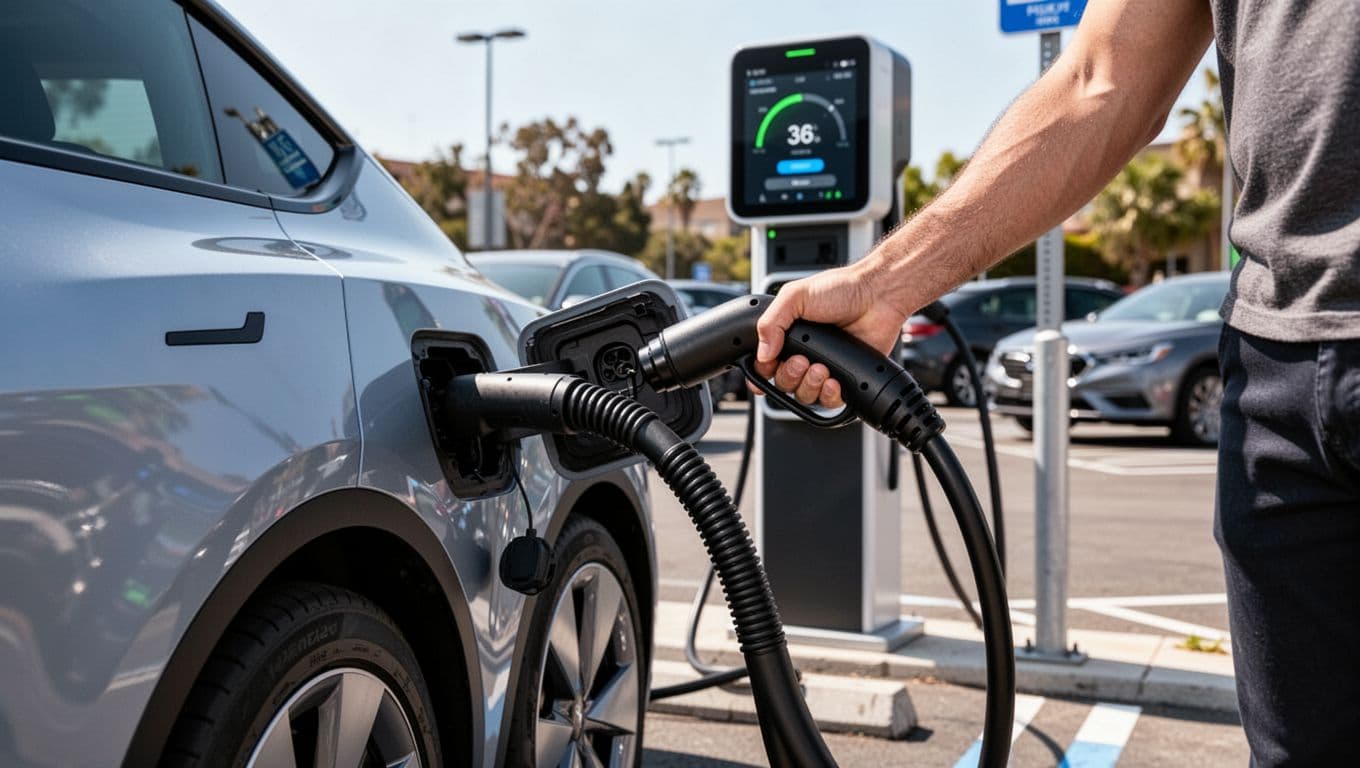 Public DC fast charging uses a thick, station-tethered cable designed for high current.
Fast charging basics, what the cable does, and what it doesn’t
A charging cable is a lot like a garden hose. A bigger hose can carry more water, but only if the faucet and the sprinkler can use it. EV charging works the same way. The cable must handle current and heat safely, yet it rarely sets the top speed by itself.
In the US, you’ll see three common charging “levels”:
- Level 1 (AC, 120 V): A regular outlet, slow and best for emergencies or low daily miles.
- Level 2 (AC, 240 V): Home and workplace charging, typically the daily workhorse.
- DC fast charging (often called Level 3): Road-trip charging, high power, short stops.
One key detail surprises new owners: at most DC fast chargers, the cable is attached to the station. You don’t bring your own DC cable to a highway charger. Instead, you bring the car, choose the right connector (or adapter), and the station’s tethered cable does the heavy lifting.
That DC cable is thick for a reason. High current means more resistive heat (I²R losses). If the cable gets too hot, the station must reduce power or stop. So cable design focuses on conductor size, insulation, strain relief, and sometimes active cooling.
If you want context on how public fast charging networks deploy these tethered cables and power cabinets, this NACS vs. CCS explainer for EV shoppers is a clear, US-focused summary.
AC vs DC charging in simple terms
AC charging sends alternating current into the car. Then the car’s onboard charger converts it to DC for the battery. That onboard charger is a hard limit, so even a great Level 2 cable can’t exceed what your car’s AC hardware supports.
DC fast charging skips that step. The station converts AC from the grid into DC and feeds it directly to the battery system (through the car’s battery controls). That’s why DC fast charging can be dramatically quicker.
In real use, DC fast charging often adds roughly 100 to 250 miles in about 30 to 45 minutes, depending on the vehicle, the charger, the battery temperature, and how full the pack already is. Those numbers vary because the system constantly protects the battery from heat and lithium plating.
The real speed limit is usually your car and the charger, not your cable
Even with the right connector, charging speed follows a curve. Many EVs pull high power at low state of charge, then taper as the battery fills. That taper often becomes obvious above about 70 percent to 80 percent.
Voltage class matters too. Many EVs are 400 V class. Some newer models use 800 V systems. On an 800 V car, a 350 kW station can deliver high power without extreme current. On a 400 V car, the same power can require more current, which creates more heat in cables and contact pins.
A simple example keeps expectations realistic: if your EV tops out at 150 kW, plugging into a 350 kW dispenser won’t make it charge faster. You might still choose the 350 kW unit because it can sustain power better, but your car remains the cap.
For a broader view of how connector standards coexist worldwide (useful if you travel or read global specs), ABRP’s 2026 connector directory gives a quick, current map of what’s used where.
Connector types in 2026: Choose the plug that fits your EV
In February 2026, the US market is in a transition, but it’s not chaos if you know the names. Most drivers only need to recognize a few connector families and what each one can do.
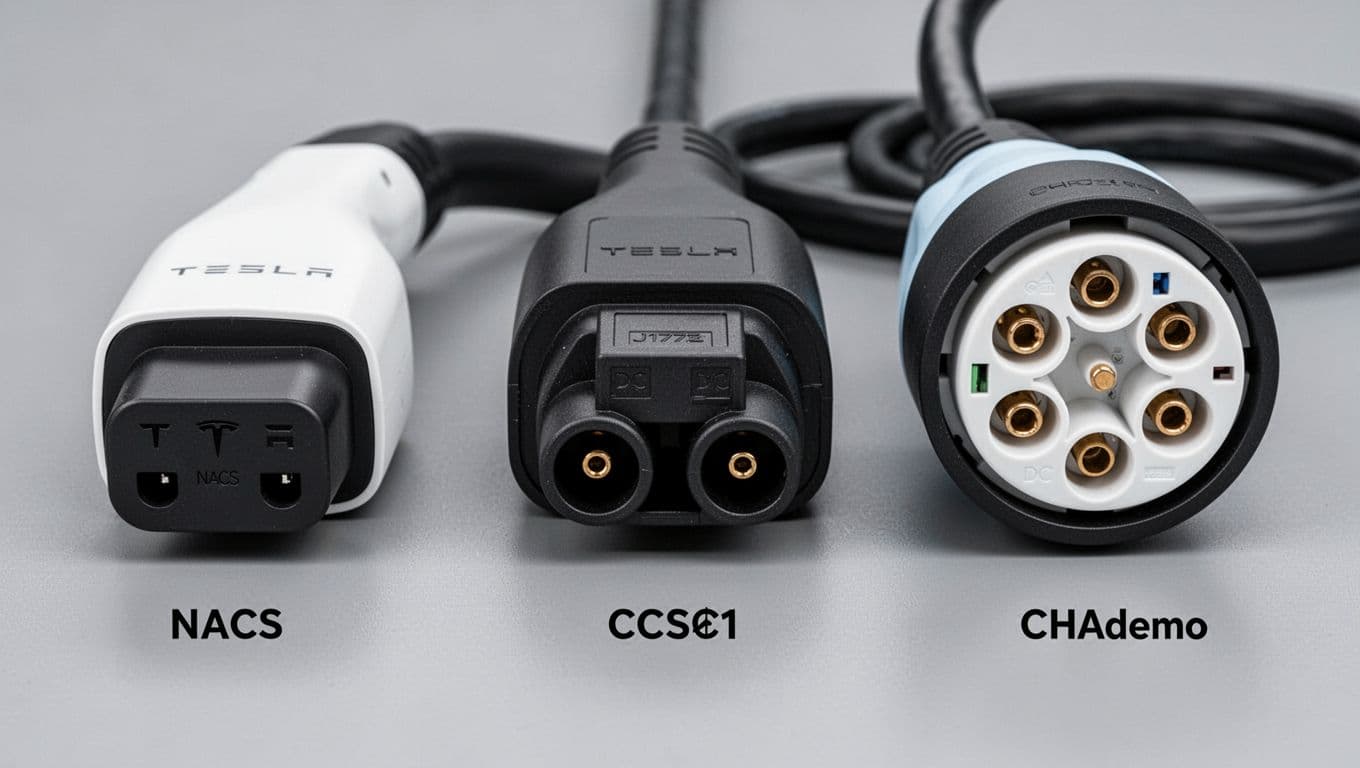
The main DC fast charging connector types you’ll encounter are:
- NACS (SAE J3400): Increasingly common in North America, originally Tesla’s design.
- CCS1: Still widespread on existing non-Tesla stations and many older EVs.
- CHAdeMO: Older standard, shrinking footprint in new installs.
- GB/T: Common in China, not a US public standard.
Adapters can bridge gaps, but they’re not magic. Some are AC-only. Some support DC but limit power. Others need vehicle software support for billing and handshake features.
If you want a quick way to identify your port and understand what each connector is for, see this internal guide on EV charging connector types in the USA.
NACS vs CCS vs CHAdeMO, the quick guide
NACS (SAE J3400) is now the direction of travel in the US. It’s compact, supports AC and DC in one inlet, and it’s being adopted by many automakers for new North American models. For background on the standardization history, Wikipedia’s overview of the North American Charging Standard explains how it became SAE J3400.
CCS1 remains very important because it’s already installed across a large part of the public DC network. CCS (as a family) can support high power; in practice, your session is limited by the car, the site, and the dispenser.
CHAdeMO mostly serves older vehicles (for example, certain Nissan LEAF model years). It can still be useful, but it’s fading in new vehicle launches and many new station builds.
Quick reality check: the connector decides whether you can plug in. Your EV and the charger decide how fast energy flows.
For drivers planning a road trip through dense fast charging corridors, an internal reference like this NYC and Upstate Electrify America charger guide can help set expectations about connector availability at real stations.
How to confirm what your car supports before you buy anything
Don’t buy a cable or adapter based on brand alone. Model year and trim can change the port and charging limits.
Use this short checklist:
- Look at the charge port shape on your car. Take a photo for reference.
- Check the car manual or in-car charging screen for supported connectors and max DC kW.
- Use the manufacturer app if it lists “max DC fast charging rate” or “peak kW.”
- Check the label near the inlet if your EV has one (some do).
- Match the adapter to the use case, AC-only versus DC-capable.
If you’re shopping for a cross-compatibility adapter, verify it supports the correct communication protocol and safety interlocks, not just the physical fit.
What to look for in a safe, reliable fast charging cable setup
Because most DC cables are station-tethered, personal purchases usually fall into four buckets: Level 2 charging cables, portable Level 2 EVSE units (cable plus control box), adapters, and “extensions” (which are usually a bad idea).
For AC Level 2 at home, you might buy a replacement cable for a wall unit, or a portable EVSE that plugs into a 240 V receptacle. Here, build quality matters because heat and flex fatigue add up over years.
Look for:
- Recognized safety certification (UL listed or ETL equivalent in the US).
- Weather rating if used outdoors (an IP rating or equivalent enclosure rating).
- Strain relief and handle ergonomics, because bent cables fail early.
- Cold-weather flexibility, since stiff jackets crack easier.
- Reasonable length, because longer cables add resistance and trip hazards.
As a reference for connector naming and what’s used at stations right now, this EV connector types guide is a straightforward walkthrough with good visuals.
Ratings that matter, amps, volts, kW, and cable cooling
Power is simple in concept: volts times amps equals watts (kW is 1,000 watts). The details still matter because cables and connectors are current-limited and heat-limited.
For home AC Level 2:
- A 240 V setup at 32 A is about 7.7 kW.
- A 240 V setup at 40 A is about 9.6 kW.
- Higher-power home charging exists, but your circuit, EVSE, and car must match.
For DC fast charging:
- Stations can deliver high voltage and high current.
- Very high current creates heat at the pins and in the cable.
- Many high-power dispensers use liquid-cooled cables to keep the handle size manageable and prevent overheating at sustained loads (often when current climbs above roughly the 200 A range, depending on design).
If you ever wondered why some “fast charging electric car cable” handles feel surprisingly light while still delivering high power, cooling and higher voltage operation are usually the reason.
Safety and durability checks you can do in one minute
Cables fail in predictable ways. A quick inspection prevents most problems.
Run this routine before plugging in (especially if the cable is yours):
- Check for cracked insulation or deep cuts.
- Look for bent, recessed, or discolored pins.
- Feel for loose handle halves or rattles.
- Watch for burn marks around the pin face.
- Notice if the jacket feels sticky, swollen, or unusually stiff.
Also, keep habits simple. Don’t drop the handle. Don’t pull the connector out by the cord. Keep contacts clean and dry. If a connector gets unusually hot, or your EVSE trips breakers repeatedly, stop using it and troubleshoot.
Choose products with clear certification markings and a real model number. Uncertified cables can run hot at their “printed” rating.
Common mistakes that slow charging or damage gear (and the easy fixes)
Most charging headaches come from a few repeat problems. Fixing them is more about process than tools.
A big one is mixing up what you control. You control the connector fit, adapter choice, and cable condition. The station and vehicle control the power level, taper, and thermal limits.
If you want to reduce trip stress, it also helps to plan around reliable networks and high-power sites. For New York drivers, this internal roundup of the fastest EV chargers in New York can help you choose stations that match your car’s peak rate.
Buying the wrong cable or relying on the wrong adapter
The “right” cable depends on whether you’re charging with AC or DC.
- For home Level 2, you need an AC cable (often J1772, or NACS depending on your EVSE and car).
- For public DC fast charging, you usually don’t buy a cable, but you might buy an adapter to use a different station connector.
Adapter mistakes are common because sellers blur the difference between AC and DC. Some adapters only pass AC signaling and aren’t built for high-voltage DC. Even DC-capable adapters can have power limits based on temperature, contact design, and the supported protocol.
Before you buy, verify:
- AC-only vs DC fast charging support
- Voltage and current rating
- Any stated kW cap
- Vehicle compatibility list, including model years
If the product page doesn’t clearly state these, skip it.
Expecting the same speed every time at a DC fast charger
DC fast charging is not a fixed speed service. Several real conditions change it.
Cold batteries slow charging because the car protects the cells. Many EVs can precondition the pack when you set a DC charger as the navigation destination. Crowded sites can also slow things down if the station shares power across stalls. Finally, arriving at a high state of charge reduces power because the charge curve tapers.
Three simple habits help:
- Arrive lower when practical (often 10 percent to 20 percent) for the quickest ramp.
- Precondition when the car supports it, especially in winter.
- Match station power to your car’s peak rate, so you’re not hunting for 350 kW when your car can’t use it.
Conclusion
A “fast charging electric car cable” isn’t just a piece of wire. It’s the connector type, the safety rating, the heat limits, and the car to charger handshake working together. Start by confirming your port (NACS, CCS1, or CHAdeMO), then learn your EV’s max DC kW so you know what “fast” looks like for your model. Most importantly, stick with certified cables and adapters, and stop using gear that shows heat damage or pin wear. Check your port today, confirm your charging limits in the app or manual, and you’ll avoid the slow sessions that feel like watching paint dry.